


This post is not, strictly speaking, about a book, yet it is hemisemidemi-qualified for TeaReads. There is a book catalogue - - yes, the old-fashioned, mail-order kind - - to which I've subscribed for several years. It is a collection of recent publications (within the past couple of years), older books and things you never heard, plus a few items you'll wish you never heard of. There is also an adults-only section.
This catalogue has a Website: www.edwardrhamilton.com.
I do not use the Website because there is a (small) surcharge, and because I am so fond of mail-order purchases, but it does offer a larger selection than does the paper catalogue.
After beginning a new job this week, I sent a small order to Edward R. Hamilton. I find it takes about two weeks from the day I pop my order into the mail until the day I lug the new books off my doorstep and into my house. The shipping charge is always $3.50, a steal for large and/or heavy orders. Most of the prices are discounted, and the books' conditions are noted, as some may be shopworn.There is quite a variety available from ERH. Over the years, I have purchased the biography of John Adams, two compendia of Charles Addams cartoons, a cookbook, an illustrated guide to physical therapy exercises, a murder mystery and a book on quilting, among others. There are coffee table books, including one I covet (a book on the art of Klimt), weird and bizarre books, children's books, videotapes, DVDs, cassette tapes and more. Even if you purchase nothing, you'll enjoy browsing.
Friday, August 25, 2006

Wednesday, August 23, 2006
Goodbye, Summer Reading Challenge
I tried. I didn't fail completely. I read more books, more closely, than I would have otherwise. Thank you, Amanda - it was a great idea!
Next time, I shall challenge myself to a number of books, or a ratio of fiction to nonfiction, or discovering a new poet every month. I should have known myself better than to select specific titles months in advance. It was way too much like following a syllabus. By the time I finished my B.A. in English literature, way back in 1975, I had developed a lifelong allergy to Required Reading - even if the Requiring was self-inflicted!
The list of books also deprived me of this bookish soul's joy in discovering a book and plunging right in.
So, here's my list. I finished the ones in bold type:
Ackerman, Diane. An alchemy of mind.
Armstrong, Karen. A short history of myth.
Armstrong, Karen. The spiral staircase.
Briggs, Julia. Virginia Woolf, an inner life.
Bronte, Emily. Wuthering Heights.
Byatt, A.S. The biographer's tale
Clarke, Gerald. Capote: a biography.
Jewett, Sarah Orne. The country of the pointed firs.
Klinkenborg, Verlyn. Timothy, or, notes of an abject reptile.
Macmillan, Margaret. Women of the Raj.
Maddox, Brenda. Yeats's ghosts: the secret life ot W.B. Yeats.
Meade, Marion. Bobbed hair and bathbub gin.
Nabokov, Vladimir. Lolita.
Prose, Francine. A changed man.
See, Lisa. Snow flower and the secret fan.
Tan, Amy. Saving fish from drowning.
I did start Yeats's Ghosts, but decided to apply Nancy Pearl's rule about reading 50 pages of a book and asking oneself, are you enjoying it? I was not enjoying it at all.
I chose the book because I love Yeats, and because the book promised a deep examination of the role of the subconscious and archetypes in his creative process. It may do so, but I find the book so tedious and plotting that I am bored. That is so rare, especially in a biography! Alas...
****************
I discovered a few more bookish blogs and added them to the sidebar. I'd love discover more! Any suggestions?
Next time, I shall challenge myself to a number of books, or a ratio of fiction to nonfiction, or discovering a new poet every month. I should have known myself better than to select specific titles months in advance. It was way too much like following a syllabus. By the time I finished my B.A. in English literature, way back in 1975, I had developed a lifelong allergy to Required Reading - even if the Requiring was self-inflicted!
The list of books also deprived me of this bookish soul's joy in discovering a book and plunging right in.
So, here's my list. I finished the ones in bold type:
Ackerman, Diane. An alchemy of mind.
Armstrong, Karen. A short history of myth.
Armstrong, Karen. The spiral staircase.
Briggs, Julia. Virginia Woolf, an inner life.
Bronte, Emily. Wuthering Heights.
Byatt, A.S. The biographer's tale
Clarke, Gerald. Capote: a biography.
Jewett, Sarah Orne. The country of the pointed firs.
Klinkenborg, Verlyn. Timothy, or, notes of an abject reptile.
Macmillan, Margaret. Women of the Raj.
Maddox, Brenda. Yeats's ghosts: the secret life ot W.B. Yeats.
Meade, Marion. Bobbed hair and bathbub gin.
Nabokov, Vladimir. Lolita.
Prose, Francine. A changed man.
See, Lisa. Snow flower and the secret fan.
Tan, Amy. Saving fish from drowning.
I did start Yeats's Ghosts, but decided to apply Nancy Pearl's rule about reading 50 pages of a book and asking oneself, are you enjoying it? I was not enjoying it at all.
I chose the book because I love Yeats, and because the book promised a deep examination of the role of the subconscious and archetypes in his creative process. It may do so, but I find the book so tedious and plotting that I am bored. That is so rare, especially in a biography! Alas...
****************
I discovered a few more bookish blogs and added them to the sidebar. I'd love discover more! Any suggestions?
Monday, August 07, 2006
An article from The Chicago Tribune: Nyala Press
I came across this article in The Chicago Tribune:
Ethiopian Publisher is Looking for Simple, Noble, Human Stories

This link will take you to a fascinating story about Ethiopian
publisher,Fassil Yirgu. The Nyala  Press publishes immigrants'
writings about their journeys to and in America.  Perhaps this is
of especial interest to me because I am a first-generation
American on one side of my family,and a second-generation
American on the other side.So many families have stories
about coming to America!

Follow this link to Nyala Publishing, to learn how to order a
book that is on my personal reading list, The Texture of
Dreams.  It is a work of fiction by immigrant author, Fasil
Yitbarek, telling the story of anEthiopian man who moved to
New York City.

Sometimes the way to see your own home is through the
eyes of a newcomer,and this book will provide that perspective.

There are other selections from African authors on the Nyala
site.I believe they are worth a look, based on an experience I
had several years ago.  My local public library offered
screenings of movies made in countries all over Africa.
Almost all of them were exceedingly good, surpassing much
of the popular fare in American cinema.  They were fresh and
new, rich in detail, they had stories to tell, and the imagery
was gorgeous. Every single movie left me thinking about it
for a long time.  I think all of that probably finds its way into
the books such as The Texture of Dreams.
--- SilverMoonRani --
Friday, August 04, 2006
Would you like to peek...
at my summer reading list? It's not a list, really, but a stack of books in the living room, plus one or two which I plan to buy in a more prosperous time.
My summer reading began with Blue Monday, by Rick Coleman (see post, "Of Domino and rock 'n' roll"). Having had a glimpse into the rich gumbo that is the blues and early rock and roll whetted my appetite. Perhaps my appetite can be slaked by my future purchase, The Language of the Blues: from Alcorub to Zuzu, by Debra DeSalvo. So many words and phrases, common and uncommon, originated in one place or another, were then picked up by blues artists and continue today, though frequently not with their original meanings. This book is a blues dictionary, backed up by painstaking research. I'm in love with dictionaries anyway, and this one will make a fine addition to my collection.
My current read is from the true-crime bookshelf. Eye of the Beholder, by Lowell Cauffiel, details the gunshot murder of Michigan television news personality, Diane Newton King. Clues are sparse; there seems to be no motive. Ms. Newton King left a husband and two babies. Are their lives also endangered by her killer? Did the police manage to stitch together what happened from the patches of evidence they collected, or did this remain a mystery? Well, you'll just have to read for yourself and learn. caveat: Mr. Cauffiel needed a crack editor, but didn't get one.
Next in my book stack is another self-improvement guide. You see, I'm hopelessly reclusive and socially backward. But perhaps reading the critically-praised The Art of Civilized Conversation will give me a modicum of sophistication on the rare occasions I do venture Out Among People. If so, I can thank the author, Margaret Shepherd (with Sharon Hogan). Ms. Shepherd also wrote The Art of the Handwritten Note, in case you, dear reader, wish to polish your epistolary skills.
Attempting to educate myself is an ongoing process, as the book above shows. The next two books in my stack are also self-improvement tomes. The first is The Well-Educated Mind: A Guide to the Classical Education You Never Had, by Susan Wise Bauer. The second is an older book that was rereleased recently, The Trivium: The Liberal Arts of Logic, Grammar and Rhetoric, by Sister Miriam Joseph, CSC; PhD. Can I play Pygmalian to my own Galatea? Maybe. I'll let you know how educated and sophisticated I become, dear reader.
A friend recommended the last book in my stack, The Seven Levels of Intimacy, by Matthew Kelly. The book's subtitle is The Art of Loving and the Joy of Being Loved. The dust jacket notes say this book is "a brilliant and practical guide to creating and sustaining intimacy," and go on to say that this intimacy can be between romantic partners, parents and children, or in other love relationships. I missed seeing the author speak several months ago, but my friend's recommendation intrigued me enough that I bought the book.
There may be other books in my stack, but these are enough for now. Now if you'll excuse me, I want to go read...
My summer reading began with Blue Monday, by Rick Coleman (see post, "Of Domino and rock 'n' roll"). Having had a glimpse into the rich gumbo that is the blues and early rock and roll whetted my appetite. Perhaps my appetite can be slaked by my future purchase, The Language of the Blues: from Alcorub to Zuzu, by Debra DeSalvo. So many words and phrases, common and uncommon, originated in one place or another, were then picked up by blues artists and continue today, though frequently not with their original meanings. This book is a blues dictionary, backed up by painstaking research. I'm in love with dictionaries anyway, and this one will make a fine addition to my collection.
My current read is from the true-crime bookshelf. Eye of the Beholder, by Lowell Cauffiel, details the gunshot murder of Michigan television news personality, Diane Newton King. Clues are sparse; there seems to be no motive. Ms. Newton King left a husband and two babies. Are their lives also endangered by her killer? Did the police manage to stitch together what happened from the patches of evidence they collected, or did this remain a mystery? Well, you'll just have to read for yourself and learn. caveat: Mr. Cauffiel needed a crack editor, but didn't get one.
Next in my book stack is another self-improvement guide. You see, I'm hopelessly reclusive and socially backward. But perhaps reading the critically-praised The Art of Civilized Conversation will give me a modicum of sophistication on the rare occasions I do venture Out Among People. If so, I can thank the author, Margaret Shepherd (with Sharon Hogan). Ms. Shepherd also wrote The Art of the Handwritten Note, in case you, dear reader, wish to polish your epistolary skills.
Attempting to educate myself is an ongoing process, as the book above shows. The next two books in my stack are also self-improvement tomes. The first is The Well-Educated Mind: A Guide to the Classical Education You Never Had, by Susan Wise Bauer. The second is an older book that was rereleased recently, The Trivium: The Liberal Arts of Logic, Grammar and Rhetoric, by Sister Miriam Joseph, CSC; PhD. Can I play Pygmalian to my own Galatea? Maybe. I'll let you know how educated and sophisticated I become, dear reader.
A friend recommended the last book in my stack, The Seven Levels of Intimacy, by Matthew Kelly. The book's subtitle is The Art of Loving and the Joy of Being Loved. The dust jacket notes say this book is "a brilliant and practical guide to creating and sustaining intimacy," and go on to say that this intimacy can be between romantic partners, parents and children, or in other love relationships. I missed seeing the author speak several months ago, but my friend's recommendation intrigued me enough that I bought the book.
There may be other books in my stack, but these are enough for now. Now if you'll excuse me, I want to go read...
Wednesday, August 02, 2006
Very Selective Book Meme
Very Selective Book Meme
(stolen from The Library Ladder: Orange Blossom Goddess a/k/a Heather)
1. One book that changed your life:
Jane Eyre. I read it when I was about 10, for the first time - I remember that I bought a used, hardback copy in the old Barnes & Noble, downtown, Fifth Avenue. My parents had taken me there as a treat, so you know what manner of child I was. (The child is mother to the woman, eh?) I still have that copy, and I can open to any page and read with pleasure.
2. One book that you've read more than once:
Everyone seems to be saying Little Women, and that would be one of mine, too - but I'll say Mrs. Dalloway, which I practically have memorized.
3. One book you'd want on a desert island:
Savage Beauty (biography of Edna St. Vincent Millay) -Nancy Mitford. (The meme doesn't say the ONLY book...)
4. One book that made you laugh:
I'm reading Lolita right now, and it's drop-dead funny, despite (because of?) the sheer monstrousness of Humbert Humbert, and the utterly awful object of his desire. Nabokov's language is outrageously funny and beautiful, and now I know why Amy Tan reads this book yearly, just to plunge into the language.
5. One book that made you cry:
Dorothy Parker: What Fresh Hell Is This?, by Marion Meade. Something about Dorothy Parker touches my heart, and Meade illuminates this sad, frustrated life. Another woman whose biographies make me cry: Zelda Fitzgerald.
6. One book you wish you had written:
The Time Traveller's Wife.
7. One book you wish had never been written:
Heather said, "I can’t say there are any books I wish hadn’t been written…just books I wish I hadn’t read." Ditto.
8. One book you're currently reading:
Yeats's Ghosts - Brenda Maddox.
9. One book you've been meaning to read:
A Changed Man - Francine Prose. It's on my Summer Reading Challenge list, and I'm going to read it before September begins. I am. I am!
Anyone who is reading this may consider herself tagged.
(stolen from The Library Ladder: Orange Blossom Goddess a/k/a Heather)
1. One book that changed your life:
Jane Eyre. I read it when I was about 10, for the first time - I remember that I bought a used, hardback copy in the old Barnes & Noble, downtown, Fifth Avenue. My parents had taken me there as a treat, so you know what manner of child I was. (The child is mother to the woman, eh?) I still have that copy, and I can open to any page and read with pleasure.
2. One book that you've read more than once:
Everyone seems to be saying Little Women, and that would be one of mine, too - but I'll say Mrs. Dalloway, which I practically have memorized.
3. One book you'd want on a desert island:
Savage Beauty (biography of Edna St. Vincent Millay) -Nancy Mitford. (The meme doesn't say the ONLY book...)
4. One book that made you laugh:
I'm reading Lolita right now, and it's drop-dead funny, despite (because of?) the sheer monstrousness of Humbert Humbert, and the utterly awful object of his desire. Nabokov's language is outrageously funny and beautiful, and now I know why Amy Tan reads this book yearly, just to plunge into the language.
5. One book that made you cry:
Dorothy Parker: What Fresh Hell Is This?, by Marion Meade. Something about Dorothy Parker touches my heart, and Meade illuminates this sad, frustrated life. Another woman whose biographies make me cry: Zelda Fitzgerald.
6. One book you wish you had written:
The Time Traveller's Wife.
7. One book you wish had never been written:
Heather said, "I can’t say there are any books I wish hadn’t been written…just books I wish I hadn’t read." Ditto.
8. One book you're currently reading:
Yeats's Ghosts - Brenda Maddox.
9. One book you've been meaning to read:
A Changed Man - Francine Prose. It's on my Summer Reading Challenge list, and I'm going to read it before September begins. I am. I am!
Anyone who is reading this may consider herself tagged.
Monday, July 24, 2006
Booked to Die
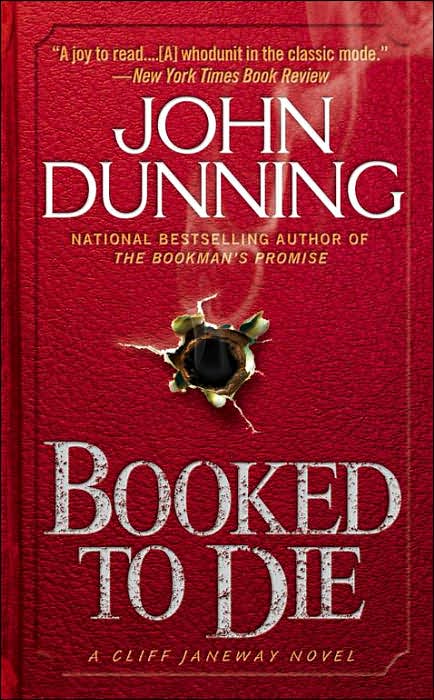
Booked to Die is the first in the Cliff Janeway series by John Dunning. I don't have much reading time lately and prefer to listen. It makes the time pass by easier when I'm doing what little housework that I don't manage to avoid.
What I went through to be able to listen.... I couldn't find a copy on CD. I was resourceful, though; I downloaded a copy from NetLibrary. That was easy enough, except that NetLibrary only works with Windows. I have an old Toshiba laptop that has caused me nothing but grief. I would have sold it years ago but it does such bizarre things that I consider it unsellable. I'm to the point where as long as I can use it to print a few pictures and listen to a book, I'm fine.
Long story short, I was happily moving along through the recording, at the eight-hour mark, when I moved the laptop and suddenly was met by a screen too dark to do anything. I used my wonderfully reliable Mac to check out the Toshiba help files ... and a short time later I'm armed with a couple of screwdrivers, practically beating up the thing. [literally. really.]
Cliff Janeway is a former police detective turned book dealer. Dunning himself is a full-time writer and book dealer, having owned the Old Algonquin Bookstore in Denver for ten years. Booked to Die won the Nero Wolfe award.
Dunning's biography is as interesting as his writing. Check it out here. Like me, Dunning has an affection for old typewriters:
"This may explain my affection for typewriters," he says. "Unlike a computer, a great old manual typewriter is an honest machine. You do your work, it does its work. There's no sneaky nonsense, no hidden screens that pop up and won't go away, and at no time in my 35 years as a writer have I ever 'lost' anything because I hit a certain key, failed to hold my mouth right, or sneezed at the wrong moment."
Luddites unite! (says the gadget girl)
Saturday, July 22, 2006
Capote , as if by wizardry
I toyed, briefly (see Tea Leaves), with the idea of reading Proust instead of my Summer Reading Challenge books. The idea did not toy back. It's just not the right time for me.
Instead, I plunged into Gerald Clarke's Capote. Since I'm only 1/3 through the book, I suppose I should wait to post - but - I can't contain my enthusiasm. It reads more like a novel than many novels - the characters, even the minor ones, are living, breathing, catty, yearning people. The plot begins like a Southern Gothic, with Truman alternating living with three wierd sisters and his self-centered, self-delusional parents. He comes to New York and, as if by wizardry, becomes the beloved sprite of the publishing world before finishing his first novel.
I remember Truman Capote's appearances on television in the time of In Cold Blood and after. The black-and-white ball glittered in my imagination. Capote himself would go on talk shows, sprawl in the guest-seat, and speak in that baby-voice, his words either dripping with sarcasm or honeyed with admiration. Clarke's book captures what I remember, and illuminates what went on behind that very public life.
I can't wait to read more. (Thank you, SilverMoonRani, for giving me the idea to read it!)
Instead, I plunged into Gerald Clarke's Capote. Since I'm only 1/3 through the book, I suppose I should wait to post - but - I can't contain my enthusiasm. It reads more like a novel than many novels - the characters, even the minor ones, are living, breathing, catty, yearning people. The plot begins like a Southern Gothic, with Truman alternating living with three wierd sisters and his self-centered, self-delusional parents. He comes to New York and, as if by wizardry, becomes the beloved sprite of the publishing world before finishing his first novel.
I remember Truman Capote's appearances on television in the time of In Cold Blood and after. The black-and-white ball glittered in my imagination. Capote himself would go on talk shows, sprawl in the guest-seat, and speak in that baby-voice, his words either dripping with sarcasm or honeyed with admiration. Clarke's book captures what I remember, and illuminates what went on behind that very public life.
I can't wait to read more. (Thank you, SilverMoonRani, for giving me the idea to read it!)
Friday, July 14, 2006
Bobbed Hair and Bathtub Gin
Bobbed Hair and Bathtub Gin: Writers Running Wild in the Twenties - Marion Meade.
Edna St. Vincent Millay, Zelda Fitzgerald, Dorothy Parker, Edna Ferber. These names conjure a mystique, almost a mythology: bad girls, notorious woman of the Roaring Twenties.
What fresh hells (with apologies to Dorothy Parker) were behind these exemplars of the energy, freedom, and creativity of those years? Marion Meade chronicles the lives of these women, from the height of their fame through the self-destruction or disappointment of their lives.
Since many of the high points and crashes have attached to these myths, many readers may believe they already know these women. I thought I did. I am a junkie for biographies of women writers, especially writers of the twenties. When two biographies of Edna St. Vincent Millay were published within months of each other, I was ecstatic. I have read two biographies of Zelda Fitzgerald, and her novel, Save Me the Waltz. Meade's excellent biography of Dorothy Parker, What Fresh Hell is This?, was thorough, evoking both admiration and compassion for this brilliant, brittle woman. (I confess to little knowledge or interest in Edna Ferber.)
I wonder whether this book would hold the interest of a reader who was not, already, an aficionado of these women. Meade's narrative is not biographical or thematic, but chronological. Each episode of each life is presented piecemeal as the decade progresses. The advantage of this approach is that the reader is shown how these lives intertwined, and their social context. The disadvantages to this episodic approach is that the reader never learns enough about any of the women to engage the imagination.
The book ends in 1930, but not for any narrative or biographical reason. Brief end notes follow the lives of the main characters (both the writers and their friends, male and female). Honestly, familiar as I am with these women and their times, I was not sure who some of these people were.
If you're looking for a shallow overview, this is the book for you. Otherwise, invest the time in full-scale biographies. These women are worth it.
Edna St. Vincent Millay, Zelda Fitzgerald, Dorothy Parker, Edna Ferber. These names conjure a mystique, almost a mythology: bad girls, notorious woman of the Roaring Twenties.
What fresh hells (with apologies to Dorothy Parker) were behind these exemplars of the energy, freedom, and creativity of those years? Marion Meade chronicles the lives of these women, from the height of their fame through the self-destruction or disappointment of their lives.
Since many of the high points and crashes have attached to these myths, many readers may believe they already know these women. I thought I did. I am a junkie for biographies of women writers, especially writers of the twenties. When two biographies of Edna St. Vincent Millay were published within months of each other, I was ecstatic. I have read two biographies of Zelda Fitzgerald, and her novel, Save Me the Waltz. Meade's excellent biography of Dorothy Parker, What Fresh Hell is This?, was thorough, evoking both admiration and compassion for this brilliant, brittle woman. (I confess to little knowledge or interest in Edna Ferber.)
I wonder whether this book would hold the interest of a reader who was not, already, an aficionado of these women. Meade's narrative is not biographical or thematic, but chronological. Each episode of each life is presented piecemeal as the decade progresses. The advantage of this approach is that the reader is shown how these lives intertwined, and their social context. The disadvantages to this episodic approach is that the reader never learns enough about any of the women to engage the imagination.
The book ends in 1930, but not for any narrative or biographical reason. Brief end notes follow the lives of the main characters (both the writers and their friends, male and female). Honestly, familiar as I am with these women and their times, I was not sure who some of these people were.
If you're looking for a shallow overview, this is the book for you. Otherwise, invest the time in full-scale biographies. These women are worth it.
Friday, July 07, 2006
Tea Shakes
Have you ever had the tea shakes? You'll get them after you try this recipe, which I deemed appropriate for this blog. I found it in my newspaper, and will credit the originator if s/he contacts me to claim credit. This sounds divine for a summer's day.
TEA SHAKES
1 quart boiling water
6 Lipton Brisk Cup Size teabags
2 C. (1 pint) sherbet/ice cream [n.b., I think sorbet would work, too], slightly softened
Scald a teapot, then add teabags and boiling water. Cover and steep three to five minutes. Remove teabags. Chill fifteen minutes. [NB., you could chill for fifteen minutes, too, if you cool two of those used teabags and plonked one on each eye - - they're said to be soothing.] Remove teabags from eyes; save used leaves to sprinkle on bare floors to make sweeping easier [again, a note from MoonRani]. Combine 2-1/2 C. tea with sherbet in a blender. Process on high until well blended. Serve immediately [I'd chill some glasses beforehand to add to the delicious coolness of this recipe].
Tuesday, July 04, 2006
The Spiral Staircase
Before Karen Armstrong became an authority, both learned and accessible, on the religions of the world, she spent seven years in a convent. Her first memoir, Through the Narrow Gate, recounted those seven years. This book takes the reader beyond those years. through a period of intense sufferings and trials, and to the point where she discovers her true vocation.
The first part of this book recounts the end of her time in the convent. The brutal and, sometimes, absurd practices of the nuns numbed her mind and undermined her judgement. Ordered to practice sewing by a superior, she was punished for telling the older nun that the machine had no needle. ("You will go to that machine...and work on it every day, needle or no needle, until I give you permission to stop.") When she developed fainting attacks, complete with auras, she was told that she was looking for attention and sent to bed in disgrace. She lost her religious faith and faith in her academic abilities at the same time that her conscious mind became unreliable.
When she left the convent, she was emotionally exhausted and physically ill. Although she never thought that the fainting spells and terrifying visions were religious, she did believe what her doctors told her: they were "anxiety states" that could be treated by psychotherapy. (One doctor's words: "As long as you keep producing these 'interesting' psychic states, you are postponing the moment when you have to accept the unwelcome fact that when push comes to shove, you're not that interesting.")Her initial experiences in the outside world were unsatisfying and frightening. She tried to hide her lack of worldly skills with "a hard, intellectual manner that, [I] thought, provided me with some protection." The spells grew much worse as she began to find herself in places or situations but had no recollection of how she had gotten there.
Help came on a strange path: a job as a babysitter for a bright young boy with autism and epilepsy. Although her Oxford thesis had been rejected, although she began to relinquish hope for a normal life, and although she attempted suicide, she received a gift - a strange gift, but a gift, nonetheless. She fainted in a subway station and was taken to a hospital, where she was diagnosed with temporal lobe epilepsy. No longer were her fainting spells, hallucinations, or unremembered activities a sign of emotional instability: they were physical symptoms of a brain insult, and they could be treated like any other physical illness.
"I could have been as emotionally stolid as a sloth and it would have made no difference," she writes. "For many people, a diagnosis of epilepsy must be unwelcome news, but for me it was an occasion of pure happiness."
As she recovered from the strain of years of needless suffering, she began to be interested in religion again. Commissioned to write and host television pieces about religion, she began to investigate and re-think all she had been taught. Her research began as an academic exercise, but led her from one surprise to another.
Historical scholarship about the New Testament led her to realize that not even Paul had considered Jesus divine: "... even he would have been dismayed by some of the theological conclusions that were later drawn from his letters." Her research expanded to other Abrahamic faiths, and, later, to Eastern religions.
As for Judaism :"From my earliest years, I had been taught that Judaism had become an empty faith: wedded to external observances and with no spiritual dimension... [Jews] could no longer understand the spirit that had originally inspired these now soulless commandments."
A Jewish advisor, Hyam Maccoby, led her to understanding that Christianity (especially the Catholocism she knew best) did not have the same structure or expectations as other religions. "Theology is just not important in Judaism, or in any other religion, really. There's no orthodoxy as you have it in the Catholic Church. No complicated creeds to which everybody must subscribe. No infallible pronouncements by a pope. Within reason, you can believe what you like." Instead, he said, Jews have "orthopraxy": "right practice rather than right belief. That's all. ... It's just poetry, really, ways of talking about the inexpressible. We Jews don't bother much about what we believe. We just do it instead."
Her research and understanding of Islam ("surrender") led her to realize "we seemed to find it difficult to regard Muslim faith and civilization with fairness and objectivity. The stereotypical view of Islam, first developed at the time of the Crusades, was in some profound way essential to our Western identity.... Westerners had needed to hate Islam; in the fantasies they created, it became everything that they hoped that they were not, and was made to epitomize everything that they feared that they were."
Ultimately, Armstrong developed her own philosophy of religion, including her conclusion about the religious ecstasy that can be found in stepping outside of one's own ego, and developing a compassionate nature that is brought to bear in all of one's dealings with the world.
Armstrong continues to research and write about religion in a way that causes this "spiritual agnostic" understand and admire its achievements even while its abuses have changed the world - especially the modern world.
The first part of this book recounts the end of her time in the convent. The brutal and, sometimes, absurd practices of the nuns numbed her mind and undermined her judgement. Ordered to practice sewing by a superior, she was punished for telling the older nun that the machine had no needle. ("You will go to that machine...and work on it every day, needle or no needle, until I give you permission to stop.") When she developed fainting attacks, complete with auras, she was told that she was looking for attention and sent to bed in disgrace. She lost her religious faith and faith in her academic abilities at the same time that her conscious mind became unreliable.
When she left the convent, she was emotionally exhausted and physically ill. Although she never thought that the fainting spells and terrifying visions were religious, she did believe what her doctors told her: they were "anxiety states" that could be treated by psychotherapy. (One doctor's words: "As long as you keep producing these 'interesting' psychic states, you are postponing the moment when you have to accept the unwelcome fact that when push comes to shove, you're not that interesting.")Her initial experiences in the outside world were unsatisfying and frightening. She tried to hide her lack of worldly skills with "a hard, intellectual manner that, [I] thought, provided me with some protection." The spells grew much worse as she began to find herself in places or situations but had no recollection of how she had gotten there.
Help came on a strange path: a job as a babysitter for a bright young boy with autism and epilepsy. Although her Oxford thesis had been rejected, although she began to relinquish hope for a normal life, and although she attempted suicide, she received a gift - a strange gift, but a gift, nonetheless. She fainted in a subway station and was taken to a hospital, where she was diagnosed with temporal lobe epilepsy. No longer were her fainting spells, hallucinations, or unremembered activities a sign of emotional instability: they were physical symptoms of a brain insult, and they could be treated like any other physical illness.
"I could have been as emotionally stolid as a sloth and it would have made no difference," she writes. "For many people, a diagnosis of epilepsy must be unwelcome news, but for me it was an occasion of pure happiness."
As she recovered from the strain of years of needless suffering, she began to be interested in religion again. Commissioned to write and host television pieces about religion, she began to investigate and re-think all she had been taught. Her research began as an academic exercise, but led her from one surprise to another.
Historical scholarship about the New Testament led her to realize that not even Paul had considered Jesus divine: "... even he would have been dismayed by some of the theological conclusions that were later drawn from his letters." Her research expanded to other Abrahamic faiths, and, later, to Eastern religions.
As for Judaism :"From my earliest years, I had been taught that Judaism had become an empty faith: wedded to external observances and with no spiritual dimension... [Jews] could no longer understand the spirit that had originally inspired these now soulless commandments."
A Jewish advisor, Hyam Maccoby, led her to understanding that Christianity (especially the Catholocism she knew best) did not have the same structure or expectations as other religions. "Theology is just not important in Judaism, or in any other religion, really. There's no orthodoxy as you have it in the Catholic Church. No complicated creeds to which everybody must subscribe. No infallible pronouncements by a pope. Within reason, you can believe what you like." Instead, he said, Jews have "orthopraxy": "right practice rather than right belief. That's all. ... It's just poetry, really, ways of talking about the inexpressible. We Jews don't bother much about what we believe. We just do it instead."
Her research and understanding of Islam ("surrender") led her to realize "we seemed to find it difficult to regard Muslim faith and civilization with fairness and objectivity. The stereotypical view of Islam, first developed at the time of the Crusades, was in some profound way essential to our Western identity.... Westerners had needed to hate Islam; in the fantasies they created, it became everything that they hoped that they were not, and was made to epitomize everything that they feared that they were."
Ultimately, Armstrong developed her own philosophy of religion, including her conclusion about the religious ecstasy that can be found in stepping outside of one's own ego, and developing a compassionate nature that is brought to bear in all of one's dealings with the world.
Armstrong continues to research and write about religion in a way that causes this "spiritual agnostic" understand and admire its achievements even while its abuses have changed the world - especially the modern world.
Thursday, June 29, 2006
Of Domino and rock & roll
Perhaps it is downright heresy to write of this here, but I do live dangerously, so...I am having coffee as I read this morning! There, kick me off the TeaReads blog, but the truth is coffee is my morning companion, and nothing else will do. Perhaps coffee is fitting as I read a book that is set in, around and about an American city much in the the national conciousness for nearly a year now, New Orleans, a city known for strong coffee (hold the chicory for me, please).
Can you imagine any connection linking Napoleon, Plessy v. Feguson, the 1791 Haitian Revolution, Pat Boone, John Lennon and Fats Domino? No, it isn't a certain date, but that's a good guess. To find the common thread among these disparate factors, you'll simply have to read Blue Monday: Fats Domino and the Lost Dawn of Rock 'N' Roll. This is no meager, pallid recitation of half-supported facts, but a vivid and visceral historical tracing showing the inextricable path from the African diaspora via slavery to Louisiana's earliest recorded days to the advent and development of rock and roll.
But does that sound dry? What a disservice I have done, if so! This book, by Rick Coleman, is vital and juicy, sometimes bloodsoaked and sorrowful, and always gripping as it shows how rock and roll could not have been had there never been a New Orleans nor a Fats Domino. It is rich in historical moment and in geographical fact.
The name Fats Domino may call to mind the now-standard songs "Blueberry Hill" and "Blue Monday," and a little more thinking might also jostle to recollection "Walkin' to New Orleans" or, perhaps, a vague memory of a ripe plum of a man in suit and tie, but probably little more. One must read this book to find how it elevates the humble Mr. Domino to his rightful place in American musical history as one of the founding fathers of rock and roll (or, "rock 'n' roll," as the author writes it). The book conveys information on an intellectual as well as an emotional level, uncovering little-known facts and events, and bring fresh air to well-known ones, lacing the whole with quotations from those who were there and from those who have made in-depth studies of the times. Did you know, for example, that there's an old New Orleans tradition called Blue Monday? I did not until I read this book. I learned how many phrases and references in rock and roll were then-current slang terms that spoke to those in the know, meanings that have been all but lost over time, distance and geography.
And yet, for all the things that are right about this book, I must mention a thing or two that is wrong. In his clear appreciation for rock and roll and for the African roots of that genre`, Mr. Coleman draws totteringly close to a precipice. Swept up in his enthusiastic defense of the maltreated African and American Black people who built rock and roll, Mr. Coleman edges closer and closer to enshrining them as Noble Savages, whose nature is not just different to that of White people, but also superior. Loving classical music is not anthithetical to loving rock and roll music. I, myself, find room in my heart for both and for other genres` as well. A culture that is earthy in its expression is not necessarily superior to a culture that focuses on less visceral things. The African/Black view that related things to everyday life is posited to be above the European/White view that divides body, soul and mind, and which sees the soul as the acme of importance.
We read, for example, that "To the Eurocentric aesthetic, classical music was the apex of sophistication, but African-rooted music was more complex rhythmically, improvisationally, and socially - - that is, in the human terms of the everyday world." Rhythmically more complex? Really? More so than, say, Mozart, with his "too many notes?" More complex than the mathematically beautiful compositions of Bach?
Moreover, music has always served as a conduit for feelings in cultures, and few things rouse such fervent patriotism as music that is meaningful to particular societies. So how African-rooted music can be said to be more socially complex than other kinds is beyond my ken.
However...do let me leave you with a hearty recommendation for this book. It will amuse you, surprise you, inform you and challenge you. You might want to have a cuppa joe with it, too.
Can you imagine any connection linking Napoleon, Plessy v. Feguson, the 1791 Haitian Revolution, Pat Boone, John Lennon and Fats Domino? No, it isn't a certain date, but that's a good guess. To find the common thread among these disparate factors, you'll simply have to read Blue Monday: Fats Domino and the Lost Dawn of Rock 'N' Roll. This is no meager, pallid recitation of half-supported facts, but a vivid and visceral historical tracing showing the inextricable path from the African diaspora via slavery to Louisiana's earliest recorded days to the advent and development of rock and roll.
But does that sound dry? What a disservice I have done, if so! This book, by Rick Coleman, is vital and juicy, sometimes bloodsoaked and sorrowful, and always gripping as it shows how rock and roll could not have been had there never been a New Orleans nor a Fats Domino. It is rich in historical moment and in geographical fact.
The name Fats Domino may call to mind the now-standard songs "Blueberry Hill" and "Blue Monday," and a little more thinking might also jostle to recollection "Walkin' to New Orleans" or, perhaps, a vague memory of a ripe plum of a man in suit and tie, but probably little more. One must read this book to find how it elevates the humble Mr. Domino to his rightful place in American musical history as one of the founding fathers of rock and roll (or, "rock 'n' roll," as the author writes it). The book conveys information on an intellectual as well as an emotional level, uncovering little-known facts and events, and bring fresh air to well-known ones, lacing the whole with quotations from those who were there and from those who have made in-depth studies of the times. Did you know, for example, that there's an old New Orleans tradition called Blue Monday? I did not until I read this book. I learned how many phrases and references in rock and roll were then-current slang terms that spoke to those in the know, meanings that have been all but lost over time, distance and geography.
And yet, for all the things that are right about this book, I must mention a thing or two that is wrong. In his clear appreciation for rock and roll and for the African roots of that genre`, Mr. Coleman draws totteringly close to a precipice. Swept up in his enthusiastic defense of the maltreated African and American Black people who built rock and roll, Mr. Coleman edges closer and closer to enshrining them as Noble Savages, whose nature is not just different to that of White people, but also superior. Loving classical music is not anthithetical to loving rock and roll music. I, myself, find room in my heart for both and for other genres` as well. A culture that is earthy in its expression is not necessarily superior to a culture that focuses on less visceral things. The African/Black view that related things to everyday life is posited to be above the European/White view that divides body, soul and mind, and which sees the soul as the acme of importance.
We read, for example, that "To the Eurocentric aesthetic, classical music was the apex of sophistication, but African-rooted music was more complex rhythmically, improvisationally, and socially - - that is, in the human terms of the everyday world." Rhythmically more complex? Really? More so than, say, Mozart, with his "too many notes?" More complex than the mathematically beautiful compositions of Bach?
Moreover, music has always served as a conduit for feelings in cultures, and few things rouse such fervent patriotism as music that is meaningful to particular societies. So how African-rooted music can be said to be more socially complex than other kinds is beyond my ken.
However...do let me leave you with a hearty recommendation for this book. It will amuse you, surprise you, inform you and challenge you. You might want to have a cuppa joe with it, too.
Tuesday, June 27, 2006
Tea and respectability
You sipped plum tea while drinking in Snow Flower and the Secret Fan? An excellent tea choice, and one I have been known to indulge in myself. Green tea is not at the top of my drinking list; however, I do appreciate one or two of them. Snow Flower... might have been enhanced by a cuppa gunpowder tea, a drink that stands up for itself, always a plus for me. I am also fond of dragon pearls green tea, and that is nicely Sino-suggestive. Of course, TeaBird doesn't fancy green tea, so this is not a suggestion.
You know me, and yet you don't know me, as is the case for friends who seldom, if ever, meet in the flesh - - in my case, the all-too-substantial flesh. Let us imagine a visit to my home. I greet you at the door, and welcome you into my modest but comfortable dwelling. The furnishings are not new, but you can see they are cherished by the care that has been taken with them.
I sweep my arm across the breadth of the living room as I tell you to make yourself at home, then I trot into the kitchen, just a few steps away. Next thing you know the kettle's on, and I'm asking you what kind of treats you'd like for tea. Your eyes follow me even though I'm now out of sight. I'm round and curvy with a funny, little walk, silvery grey hair, dusky skin, and silver, wire-rim glasses that frame black-brown eyes. I wear a dress or a skirt and blouse - - warm colors, probably red as I love red - - earrings, a gold necklace (a family piece) and a gold family ring. I gimp about in the shoes I wear always, flat, brown, "sensible," lace-up walking shoes. I'm the picture of middle-aged, middle-class respectability.
From your worn, comfy seat, you let your eyes wander across my library. The profusion of lurid titles you see is, well, frankly bloodthirsty. These books are not the fantastical gore of horror novels, but the real gore of real murders. Glance after glance reveals one true crime book after another. As you riffle through dozens of books, you see dreadful photographs to accompany the titles, hideous descriptions of inhumane and inhuman acts; a chill caresses your spine.
Then I'm bustling through the door with a tea tray. You do like almond cookies, don't you? And Yorkshire Gold tea? It has such...such body, you know, really gets the blood pulsing....What, no cookies? Oh, but please do....I made them myself....Bitter almond? No, I think they taste fine, nicely sweet, in fact....More tea, dear? Some sherry, then? Nothing more? Oh, must you go? But you just got here, dear, and we've not had time to chat....Oh, well, of course, if you just remembered an appointment, then you're right to hurry off like that....Some cookies to take with you, dear? Dear? Oh, my, mind you don't slip while running to the car...
You know me, and yet you don't know me, as is the case for friends who seldom, if ever, meet in the flesh - - in my case, the all-too-substantial flesh. Let us imagine a visit to my home. I greet you at the door, and welcome you into my modest but comfortable dwelling. The furnishings are not new, but you can see they are cherished by the care that has been taken with them.
I sweep my arm across the breadth of the living room as I tell you to make yourself at home, then I trot into the kitchen, just a few steps away. Next thing you know the kettle's on, and I'm asking you what kind of treats you'd like for tea. Your eyes follow me even though I'm now out of sight. I'm round and curvy with a funny, little walk, silvery grey hair, dusky skin, and silver, wire-rim glasses that frame black-brown eyes. I wear a dress or a skirt and blouse - - warm colors, probably red as I love red - - earrings, a gold necklace (a family piece) and a gold family ring. I gimp about in the shoes I wear always, flat, brown, "sensible," lace-up walking shoes. I'm the picture of middle-aged, middle-class respectability.
From your worn, comfy seat, you let your eyes wander across my library. The profusion of lurid titles you see is, well, frankly bloodthirsty. These books are not the fantastical gore of horror novels, but the real gore of real murders. Glance after glance reveals one true crime book after another. As you riffle through dozens of books, you see dreadful photographs to accompany the titles, hideous descriptions of inhumane and inhuman acts; a chill caresses your spine.
Then I'm bustling through the door with a tea tray. You do like almond cookies, don't you? And Yorkshire Gold tea? It has such...such body, you know, really gets the blood pulsing....What, no cookies? Oh, but please do....I made them myself....Bitter almond? No, I think they taste fine, nicely sweet, in fact....More tea, dear? Some sherry, then? Nothing more? Oh, must you go? But you just got here, dear, and we've not had time to chat....Oh, well, of course, if you just remembered an appointment, then you're right to hurry off like that....Some cookies to take with you, dear? Dear? Oh, my, mind you don't slip while running to the car...
Monday, June 26, 2006
The mark
As usual, I make my mark with a comment or two which are, well, not quite on the mark. Your reviews always make me long to cast aside whatever I'm reading right now in order to pick up the books you describe. What a talent!
In this case, your book review reminded me of a tidbit I read in online news this weekend. It seems that Darwin's tortoise died at an age estimated to be (I believe) ~140 years. Isn't it remarkable to think of a creature that lives that long? Imagine Darwin's tortoise as the eponymous animal of the book you just reviewed...Imagine the tea one would drink while reading.
In this case, your book review reminded me of a tidbit I read in online news this weekend. It seems that Darwin's tortoise died at an age estimated to be (I believe) ~140 years. Isn't it remarkable to think of a creature that lives that long? Imagine Darwin's tortoise as the eponymous animal of the book you just reviewed...Imagine the tea one would drink while reading.
Abject reptile, indeed!
Timothy, or, Notes of an Abject Reptile - Verlyn Klinkenborg
What can I say about a tortoise whose vocabulary is wider than mine? Within the first 20 pages, I had to look up umbrageous, tegument, venerey, borecole, hirundines, and sainfroin. (Thank heavens, Timothy provided a glossary.) Timothy, the eponymous abject reptile, was not showing off. He simply was using the best, most precise words he needed for his observations - the same vocabulary that Gilbert White, a 18th-century naturalist, used when he described Timothy in The Natural History of Selborne, published in 1789.
It was White who called Timothy "abject reptile." Abject he may have seemed, but he was, really, a close observer of humanity - and not a particularly fond observer, at that.
Humans, he concluded, made their fundamental mistake when they ceased to think of themselves as animals and replaced instinct with intellect.
Timothy scoffed at the animals that humans have become. "Every garment a divorce from nature... Disdaining the flesh that keeps them from heaven ... but able to argue upward from themselves to God." He is amused particularly by sentimentality ("now the rooks are saying their prayers," says a little girl).
White writes that Timothy is "a reptile that appears to relish [life] so little as to squander more than two thirds of its existence in a joyless stupor, and be lost to all sensation for months together in the profoundest of slumbers."
"Mr. Gilbert White's stupors! How joyful are they?" sputters Timothy. As well he might.
This book is a phrase-perfect parody of a well-meaning amateur's notes. Timothy himself is a worthy companion, whose story includes a plot twist that shows just how inobservant humans can be.
Don't miss this one!
What can I say about a tortoise whose vocabulary is wider than mine? Within the first 20 pages, I had to look up umbrageous, tegument, venerey, borecole, hirundines, and sainfroin. (Thank heavens, Timothy provided a glossary.) Timothy, the eponymous abject reptile, was not showing off. He simply was using the best, most precise words he needed for his observations - the same vocabulary that Gilbert White, a 18th-century naturalist, used when he described Timothy in The Natural History of Selborne, published in 1789.
It was White who called Timothy "abject reptile." Abject he may have seemed, but he was, really, a close observer of humanity - and not a particularly fond observer, at that.
Humans, he concluded, made their fundamental mistake when they ceased to think of themselves as animals and replaced instinct with intellect.
Timothy scoffed at the animals that humans have become. "Every garment a divorce from nature... Disdaining the flesh that keeps them from heaven ... but able to argue upward from themselves to God." He is amused particularly by sentimentality ("now the rooks are saying their prayers," says a little girl).
White writes that Timothy is "a reptile that appears to relish [life] so little as to squander more than two thirds of its existence in a joyless stupor, and be lost to all sensation for months together in the profoundest of slumbers."
"Mr. Gilbert White's stupors! How joyful are they?" sputters Timothy. As well he might.
This book is a phrase-perfect parody of a well-meaning amateur's notes. Timothy himself is a worthy companion, whose story includes a plot twist that shows just how inobservant humans can be.
Don't miss this one!
Sunday, June 25, 2006
Pride and Prejudice and Romeo and Juliet and Lily and Snow Flower
I'm sipping some Adagio plum tea and contemplating how I feel about this book. The title of the blog entry says it all - except that it probably should say "Juliet and Juliet," since the eternal love in this book is between Lily and Snow Flower.
Why Pride and Prejudice? Because both ruled and warped the Chinese lives -- especially their inner lives. The historian and social observer in me recognizes that conditions in those times were difficult, sometimes brutal, and a more relaxed society might not have been able to dominate the elements or survived. Still. The physical and emotional claudrophobia that ruled the society were soul-deadening.
It occurs to me that the rigidity, ritual, and rigor of the lives of the Chinese women, and the rules that guarranteed men's absolute power over women, eliminated the possibility that men could be loved. They could be admired, they could be venerated, and they could be feared, but they could not be loved as human beings. Not one man in this book is loved. Boys are loved - but not even boys who might be less than strong and commanding. Much as I abhor and pity the lives of the women, I have to wonder how the men survived without any outlet whatsoever for their anima.
Some women found ways to love each other, although even those relationships were governed by commerce and their families' desire for status. The love of women, and the nu shu language women developed to express that love, were true miracles in that society. As always, I am awed by the strength and adaptability of women. Despite their differences, despite misunderstandings and secrets, Lily and Snow Flower were soulmates and sisters, made more beautiful and powerful by their love.
Lisa See has written an amazing book. That's all I can say. Amazing.
Why Pride and Prejudice? Because both ruled and warped the Chinese lives -- especially their inner lives. The historian and social observer in me recognizes that conditions in those times were difficult, sometimes brutal, and a more relaxed society might not have been able to dominate the elements or survived. Still. The physical and emotional claudrophobia that ruled the society were soul-deadening.
It occurs to me that the rigidity, ritual, and rigor of the lives of the Chinese women, and the rules that guarranteed men's absolute power over women, eliminated the possibility that men could be loved. They could be admired, they could be venerated, and they could be feared, but they could not be loved as human beings. Not one man in this book is loved. Boys are loved - but not even boys who might be less than strong and commanding. Much as I abhor and pity the lives of the women, I have to wonder how the men survived without any outlet whatsoever for their anima.
Some women found ways to love each other, although even those relationships were governed by commerce and their families' desire for status. The love of women, and the nu shu language women developed to express that love, were true miracles in that society. As always, I am awed by the strength and adaptability of women. Despite their differences, despite misunderstandings and secrets, Lily and Snow Flower were soulmates and sisters, made more beautiful and powerful by their love.
Lisa See has written an amazing book. That's all I can say. Amazing.
Saturday, June 24, 2006
Snow Flower and the Secret Fan
Halfway through, and I realize that I am reading through a kaleidoscope of cultural personae. The thoroughly modern American woman reads a tale of a patriarchal society that expresses its disdain for women (except as sexual objects or, pardon the expression, breeders of sons) through brutality. The pain is inflicted on women by women, footbinding (hideously and graphically described) being the most obvious example, and abuse by mothers-in-law being more subtle. The second-generation daughter of Ukrainian and White Russian Jews relates to some of the rituals (food, certainly, and using arcana to support matchmaking). The literary woman delights in vivid and sensual writing, real characters, and the powerful evoking of place.
All that aside, the love story between the two young women, Lily and Snow Flower, is extraordinary. So few Chinese women of the time were allowed to develop a lifelong friendship, a sisterhood. How lightly we take our friendships compared to these women! And how lightly we take our relatively-recent ability to choose the paths of our lives.
Also, how nonchalant we are with our literacy. The special, secret language developed amongst Chinese women, nu shu, was a type of rebellion against the isolation that was required of them. It could express poetic sentiments, or pleas for pity, and it was unreadable by men.
I probably will finish this book tomorrow - it's an amazing read. Just amazing.
All that aside, the love story between the two young women, Lily and Snow Flower, is extraordinary. So few Chinese women of the time were allowed to develop a lifelong friendship, a sisterhood. How lightly we take our friendships compared to these women! And how lightly we take our relatively-recent ability to choose the paths of our lives.
Also, how nonchalant we are with our literacy. The special, secret language developed amongst Chinese women, nu shu, was a type of rebellion against the isolation that was required of them. It could express poetic sentiments, or pleas for pity, and it was unreadable by men.
I probably will finish this book tomorrow - it's an amazing read. Just amazing.
Thursday, June 22, 2006
Never Apologize
Betty Rosenberg said it best: Never apologize for your reading tastes.
I'm more apt to listen to a book than to read one. And usually the closest I get to a classic these days is laughing at Jasper Fforde's take on things. (That Miss Haversham is wicked behind the wheel....) My tea is usually iced and, if it's after two in the afternoon, it's decaf.
Right now I'm reading Maisie Dobbs by Jacqueline Winspear. So far, so good. This book is where we meet Maisie. (I am a huge fan of book series.) It's just after World War I and she's gone into business for herself. Her card reads PSYCHOLOGIST AND INVESTIGATOR and her skills in both areas are well honed.
On a personal note, I love gadgets and one of my favorite is actually tea related. Check it out.
I'm more apt to listen to a book than to read one. And usually the closest I get to a classic these days is laughing at Jasper Fforde's take on things. (That Miss Haversham is wicked behind the wheel....) My tea is usually iced and, if it's after two in the afternoon, it's decaf.
Right now I'm reading Maisie Dobbs by Jacqueline Winspear. So far, so good. This book is where we meet Maisie. (I am a huge fan of book series.) It's just after World War I and she's gone into business for herself. Her card reads PSYCHOLOGIST AND INVESTIGATOR and her skills in both areas are well honed.
On a personal note, I love gadgets and one of my favorite is actually tea related. Check it out.
Tuesday, June 20, 2006
Tea you could trot a mouse on
I second the recommendation for PG Tips. I'm drinking some right now. It you're not careful, it can brew into "tea you could trot a mouse on," in the words of M.F.K. Fisher. (I've always loved that image. If I were artistic, I'd cross stitch a mouse dancing across a cup of tea!)

My next book is going to be Lisa See's Snow Flower and the Secret Fan (for the Summer Reading Challenge). I'm eager to read about nu shu. According to the author's note, "It is believed that nu shu, the secret-code writing used by women in a remote area of southern Hunan province - developed a thousand years ago. It appears to be the only written language in the world to have been created by women exclusively for their own use." Lisa See's website has much more information, and photographs of women who still use and teach the language.
I'm not fond of Chinese tea, so I'm afraid I will not be drinking it. However, apricots are grown in China, and I have two types of Indian tea with apricot flavoring, so my sipping will be somewhat authentic.
(No, I don't think one's tea has to match one's book. However, a friend at work commented yesterday that the envelope for my tea [Twinings Darjeeling] matched my blouse. Hmmm.)
My next book is going to be Lisa See's Snow Flower and the Secret Fan (for the Summer Reading Challenge). I'm eager to read about nu shu. According to the author's note, "It is believed that nu shu, the secret-code writing used by women in a remote area of southern Hunan province - developed a thousand years ago. It appears to be the only written language in the world to have been created by women exclusively for their own use." Lisa See's website has much more information, and photographs of women who still use and teach the language.
I'm not fond of Chinese tea, so I'm afraid I will not be drinking it. However, apricots are grown in China, and I have two types of Indian tea with apricot flavoring, so my sipping will be somewhat authentic.
(No, I don't think one's tea has to match one's book. However, a friend at work commented yesterday that the envelope for my tea [Twinings Darjeeling] matched my blouse. Hmmm.)
Bags or leaves?
Yesterday's post covered the "reads" portion of this blog's name, which leaves the second portion, "tea," for today. Given my choice of tea, I prefer loose leaves to bags every time. However, there are many good - - very good - - teas that are available in bags only. My current reading list features, in addition to Wuthering Heights, Rick Coleman's new biography of Fats Domino, Blue Monday. If you, too, would enjoy reading about this overlooked founding father of rock and roll, I humbly suggest doing so while sipping a cup of The Republic of Tea's Wild Blueberry. It's a good pairing in color and in taste.
If you are in the middle of Wuthering Heights at this time, I suggest either a good English Breakfast tea (TheRepublic of Tea makes one such, British Breakfast) , or a standard, hearty cuppa - - PG Tips is an excellent choice to fortify you to tramp through the moors, and as a restorative after all those fevered longings.
I am sure that more tea and book pairings shall arise as we read and blog. What do you sip while you read?
If you are in the middle of Wuthering Heights at this time, I suggest either a good English Breakfast tea (TheRepublic of Tea makes one such, British Breakfast) , or a standard, hearty cuppa - - PG Tips is an excellent choice to fortify you to tramp through the moors, and as a restorative after all those fevered longings.
I am sure that more tea and book pairings shall arise as we read and blog. What do you sip while you read?
Monday, June 19, 2006
Another county heard from
Like Teabird, I, too, had a passion for"Dark Shadows." I was so taken with it that I wrote novellas based on it for my own entertainment.
I was not so much taken with doom as I was with drama, passion, eerieness, Inverness capes (for heaven's sake), things occult, period costumes and settings, and mysteries. I read everything ever written by Poe and Lovecraft.
I read Wuthering Heights around this time, but did not appreciate it. Teabird got it exactly right for me: it's hard to appreciate a work that has no sympathetic characters. I prefer to have at least one character with whom to sympathize at least some of the time. However, in the interest of this blog, I picked up a copy of WH over the weekend, and shall reread it. Rereading books at different times of one's life is illuminating. While I certainly understood longing when first I read WH, I was then unable to consider the environment as a character, as Teabird says. I do think you have a point, there, Teabird, and an excellent one at that.
I also read Jane Eyre around this time, and that one spoke to me then. I had much less interest in it later in life, however.
Lately, I read a lot of nonfiction, much of it of the true crime genre. There's a lot of trash in this genre, I'm afraid - - anyone who can scrawl a few lines with a blunt Crayola gets published, and, apparently, without benefit of editing. There's an advantage of reading the old works; they were well written. I cannot accept the current trend of writing sentence fragments, using "which" when one means "this," misplacing modifiers, and so on.
But I must warn you, I'm a dyed-in-the-wool curmudgeon.
This is all for now. I really must be off to look for employment - - the gainful kind, that is. The other kind is abundant.
I was not so much taken with doom as I was with drama, passion, eerieness, Inverness capes (for heaven's sake), things occult, period costumes and settings, and mysteries. I read everything ever written by Poe and Lovecraft.
I read Wuthering Heights around this time, but did not appreciate it. Teabird got it exactly right for me: it's hard to appreciate a work that has no sympathetic characters. I prefer to have at least one character with whom to sympathize at least some of the time. However, in the interest of this blog, I picked up a copy of WH over the weekend, and shall reread it. Rereading books at different times of one's life is illuminating. While I certainly understood longing when first I read WH, I was then unable to consider the environment as a character, as Teabird says. I do think you have a point, there, Teabird, and an excellent one at that.
I also read Jane Eyre around this time, and that one spoke to me then. I had much less interest in it later in life, however.
Lately, I read a lot of nonfiction, much of it of the true crime genre. There's a lot of trash in this genre, I'm afraid - - anyone who can scrawl a few lines with a blunt Crayola gets published, and, apparently, without benefit of editing. There's an advantage of reading the old works; they were well written. I cannot accept the current trend of writing sentence fragments, using "which" when one means "this," misplacing modifiers, and so on.
But I must warn you, I'm a dyed-in-the-wool curmudgeon.
This is all for now. I really must be off to look for employment - - the gainful kind, that is. The other kind is abundant.
Subscribe to:
Posts (Atom)