


The Kitchen Boy, A Novel of the Last Tsar, by Robert Alexander, offers a fictional answer to one of the twentieth century's most intriguing mysteries, namely, what really happened to Tsar Nikolai II and his family in July 1918.
That the Tsar was forced to abdicate is historical fact. That the Tsar and Tsaritsa, their four daughters and only son were held under house arrest in Ipatiev House in Siberia for almost two years is fact. It is also fact that all seven, plus four family retainers, were shot in a cellar one gruesome morning by Communist soldiers. But speculation as to details surrounding that mass assassination has swirled ever since then.
Many of us recall the women who, from time to time in the last century, have claimed to be the Grand Duchess Anastasiya, survivor of the Romanov family murders. Ingrid Bergman starred in a movie based on such a premise. Such fancy captures the imagination - - what if?
What if a rescue plan had been launched by loyalists? What if the Russian Imperial family did not all die that cruel morning? Why did a simple execution become an hour long bloodbath? What if some Romanovs managed the improbable and escaped? How could such a thing occur?
Teasing bits of information survived the years and added to the tantalizing speculation: anonymous notes that breathe hope of rescue from unknown quarters, missing jewels which may have been taken by a royal or royal loyalist to finance royal survival, rumors of inconsistencies in the burial site of the family, and - - most enigmatic - - the fact that not all the Romanovs were found when their remains were exhumed.
What became of the missing White Russians? Who was missing? Why? Why was one member of the tiny Romanov retinue whisked away from Ipatiev House just a day before the murders? Could that person have known what really transpired?
Robert Alexander does a competent job in creating the world inside Ipatiev House. Clearly he performed extraordinary research. He writes from the perspective of the kitchen boy who served the family in exile, a boy about the age of the Heir to the throne, Aleksei Nikolaevich. As a domestic servant, Leonka, the kitchen boy, has an inside track on life inside the prison house. He sees the Romanovs not as semi-divine royals, but as a fully human family.
Mr. Alexander adds many authentic touches as he draws the reader a picture of the final two weeks the family lived. Sometimes this makes for tedious reading because of Leonka's position as an observer only, as someone outside the family intimacies, and because the very nature of imprisonment tends to be tedious. To counteract this, Mr. Alexander drops little bits and pieces along the way, then gathers those bits and pieces later to weave both the fictional resolution and the factual incidents.
This book is receiving much praise, and I expect any day to read that the movie rights have been sold. It provided me several hours of diversion during a sleepless night, and would make good vacation reading. If I were to criticize anything, I would say that more colorful details would have made the book even better. Don't just mention late in the book that Ipatiev House is surrounded by two palisades; tell us early on, and tell us how they looked, how they affected air circulation during a stifling summer, how it affected the sounds from outside. Don't just tell us that there was black tea and sour black bread, tell us about the tang and coarseness of the bread, the scorching, strong tannin bite of the tea, the way the fragrance assails the nostrils long before the tea swims past the tongue. I am a reader who loves lush details such as these. They add richness and interest, but they also serve to enhance believability.
Confidential note to Robert Alexander: "seldomly" is not a word.
Because the narrator is an ignorant kitchen boy, his perspective is limited to what is apparent. I suspect The Kitchen Boy will send many readers to their libraries and to the Internet for more information. The Tsar and Tsaritsa are fascinating players on the world history stage. Theirs is a story of Classic Greek tragedy proportions. They engineered their own hard downfall with the very things they did to preserve themselves and their country. Passionately devoted to Russia and to one another, they nevertheless stand accountable for a blood soaked reign.
This book should please mystery-lovers. I can tell you that, despite my best efforts, I did not guess the ending.
For summer entertainment, make yourself some black tea, pour it into a glass (for authenticity, don't use a cup) and pick up Robert Alexander's historical novel. For further intrigue, you might try to figure out what really happened to the Romanovs. There is, even today, disagreement among the scientists who examined the DNA in the remains as to whether the bones in the grave really are Romanov family members at all. Almost a century later, so many questions remain.
(submitted by Moon Rani)
Monday, June 25, 2007

Thursday, June 21, 2007
Booking through Thursday
Since school is out for the summer (in most places, at least), here’s a school-themed question for the week:
- Do you have any old school books? Did you keep yours from college? Old textbooks from garage sales? Old workbooks from classes gone by?
- How about your old notes, exams, papers? Do you save them? Or have they long since gone to the great Locker-in-the-sky?
Notes, exams, papers - some. I have a box of notebooks in the garage from my fifth undergrad stint. (No, I don't have five undergrad degrees. I took the long way.) Since I haven't opened the box since 1974, it's hard to know exactly what's in them, but I imagine I kept the notes from various lit courses, and from the only course I've ever taken that actually changed the way I think: biomedical ethics.
melanie
Booking Through Thursday, 21.June
"School Days, Golden Rule Days
"Since school is out for the summer (in most places, at least), here’s a school-themed question for the week:
"Do you have any old school books? Did you keep yours from college? Old textbooks from garage sales? Old workbooks from classes gone by?
"How about your old notes, exams, papers? Do you save them? Or have they long since gone to the great Locker-in-the-sky? "
I have only memories from my school days. I sold college texts and never kept other assorted school papers or books. What with moving house several times, experiencing a house fire, vandalism, thefts and weather-related damages to my possessions, I have little of anything that predates the past year or two. Perhaps my lesson is to lessen, that is to say that perhaps it is good for me to decrease my attachment to possessions.
I never kept much besides high school year books, anyway. I miss those yearbooks, but I don't miss lugging them - - and all my other many erstwhile mementos - - from home to home, then searching for places to put them. What I miss most are (1) the dictionary my grandmother gave me, and the Shakespeare collection my mother gave me, both as high school graduation gifts, and (2) the science fiction short story a friend and I wrote in high school, starring our set of friends and a few faculty members.
(submitted by Moon Rani)
Thursday, June 14, 2007
Booking through Thursday
- Do you cheat and peek ahead at the end of your books? Or do you resolutely read in sequence, as the author intended?
- And, if you don’t peek, do you ever feel tempted?
I'd like to say no, I don't cheat, because I'd like to honor the intent of the author. After all, she labored to put the words and sentences into a particular sequence to express her own particular and linear storyline, whether fictional or not.
However -
I do cheat, though not if I'm reading a mystery - what would be the point of spoiling the ending of a mystery?
I cheat a lot when I'm reading nonfiction - especially biographies - by attacking the index and plates before anything else. I make up for this egregious sin, however - I read every word of acknowledgements!
melanie
"Dessert First"
Booking Through Thursday, 14.June
"Do you cheat and peek ahead at the end of your books? Or do you resolutely read in sequence, as the author intended?
"And, if you don’t peek, do you ever feel tempted? "
I never - - but never - - peek ahead at my books. Well, there was yesterday, when I saw an intriguing chapter title further ahead in my book...and again while flipping to that page, a word on another page caught my eye, so I skipped ahead there, too...then there are the times when the book is so bad or so dull that I know I won't waste time finishing it, so I look at the ending. But, no! I absolutely, positively never peek ahead.
(submitted by Moon Rani)
Sunday, June 10, 2007
Summer coolers
Longtime readers of this blog know that I, Moon Rani, submit reviews of teas as well of books, being true to the name of the blog. Today I shall expand the definition of tea to conform with current standards, but first, a confession: I am a purist in the realm of camelia senensis. I know that most people call an herbal tisane a "tea," but I don't. I can't help it, really, it's just that I'm a born snob.
But for this post, "herbal tea" it is. When I cannot indulge in one more drop of a caffeinated drink, I do, on occasion, make herbal tea. The herbals I have at this time are from the "big boys" in the herbal tea world, Celestial Seasonings. I recall thinking myself sophisticated the first time I found and tried a CS product. It was popular among my set of female friends. We loved the colorful boxes with their quotations and fun illustrations. We loved having something different to the usual tea. CS teas seemed exotic then, and far outside our small, suburban norm.
Today I think of Celestial Seasonings as a maker of reliable, flavorful herbal teas. They offer a bounty of varieties to please most people. I am less fond of the "zinger" flavors, but I like many others.
When Housemate, who gets hot when temperatures rise above 65'F, was looking for an alternative to ice water, I turned to longtime friend, Celestial Seasonings.
First I brewed a pitcherful of True Blueberry. After it cooled, I loaded it with frozen mixed berries instead of ice. What a pretty alternative that was! Housemate had little hearts in his eyes - - for this iced tea. Once home from work, he heads directly for the refrigerator for a long, cool draught of True Blue Tea.
All that drinking led to the inevitable - - we ran out! Not to worry, however. Today I followed the same procedure with Tropic of Strawberry. It's in the fridge chilling even as I write. Soon I shall pour a shower of frozen berries into the pitcher, and serve it up to Housemate. It's small payment for his washing my car today.
I recommend, wholeheartedly, your making your summer cooler with herbal tea this summer. I promise you will be delighted with shivery coolness from your first sip! We like our tea without sweetening, but adding a splash of honey to the tea when it is hot and brewing would make a delicious drink even more so. Once I have my large pot of mint thriving, I'll add some fresh sprigs to one flavor or another when it has cooled. My next iced herbal tea shall be Country Apple Spice, also from Celestial Seasonings. I'm thinking I'll add cinnamon sticks and frozen apple slices, skins on, to that one.
Oh, and should you be asked to provide something for a refreshment table or a picnic, take an iced herbal tea. It's simplicity itself, yet so tasty. Depending on your plans, you could serve it in a clear pitcher or in a punch bowl. Add frozen fruit, or make an ice ring from the tea and add fruit to that. Edible flowers make striking additions to ice rings, too.
For another time and another post: the sensuous delights of chilled masala tea!
Here I raise my glass and say, "Cheers!" as I close this post.
(submitted by Moon Rani)
The Privilege of Youth
The Privilege of Youth is one of four autobiographies by Dave Pelzer. Mr. Pelzer chronicles his childhood, adolescence and young adulthood in these books. This particular book in the series is on a par with the others. According to Mr. Pelzer and to Richard, one of his four brothers, he, Dave, was subjected to horrific childhood abuse. His alcoholic, and probably severely disturbed, mother made Mr. Pelzer the focus of torture before, during and after her marriage to his father, also an alcoholic.
The subtitle of this book is A Teenager's Story of Longing for Acceptance and Friendship. It take the reader through a series of flashbacks to the author's teen years when he was struggling to understand normal life while moving from foster home to foster home, and while receiving frequent beatings from his schoolmates at every turn. The focus is on the happiest years of his life, which occurred in a small, California town, where - - for the first time - - he knew what is was like to have friends.
That Mr. Pelzer was in foster care is a matter of record. His home life had to have been excruciating for him to have been removed from his mother's care. In A Child Called 'It,'I recall feeling outrage when school teacher after school teacher saw blatant signs of abuse but ignored them. Finally, one teacher did the right thing and reported what she saw, beginning the process which resulted in Mr. Pelzer's survival. There were many times when Mr. Pelzer's mother could and should have been stopped if only someone had been willing to stand up and do the right thing. Outrage rises again and again through readings of these books as Mr. Pelzer becomes the abuse victim of most of his peers. Once again, someone had to see what was happening, but no one ever stopped his senseless beatings by his classmates.
I cannot explain my reaction to this book, but something about it, and about the other three books, strikes me as "off." It isn't the re-creations of teenage conversations that are written in a combination of current and 1970s slang. It isn't the way that Mr. Pelzer was thrashed and taken advantage of by his peers, nor was it the exceedingly bad decisions he made growing up. One would expect bad decisions from someone who had no concept of normal life, and one can overlook the writer's style of conveying conversations.
Still, it's what I believe the police call a "hinky" feeling that something is not what it seems. I understand that I am not the first person to question Mr. Pelzer's credibililty. On what grounds I do that I am not sure. But it feels as though there is something off-kilter in this story and in the others.
To be sure, the language of the books is simple, but that is not the problem. One could expect a tortured child to grow up with learning difficulties, and one could expect these books to be simple enough that other abused children could read them, and to profit by their reading. It's just a persistent feeling that this story is "true-ish," that is to say that is was based on true events, but embroidered, perhaps, and embellished for market value.
I do not recommend Mr. Pelzer's books to anyone who is squeamish or sensitive. But it would be interesting to learn if other readers have gotten the same feelings I got while reading these books.
(submitted by Moon Rani)
Moon Rani's BTT
"Booking through Thursday
"Almost everyone can name at least one author that you would love just ONE more book from. Either because they’re dead, not being published any more, not writing more, not producing new work for whatever reason . . . or they’ve aged and aren’t writing to their old standards any more . . . For whatever reason, there just hasn’t been anything new (or worth reading) of theirs and isn’t likely to be.
"If you could have just ONE more book from an author you love . . . a book that would be as good any of their best (while we’re dreaming) . . . something that would round out a series, or finish their last work, or just be something NEW . . . Who would the author be, and why? Jane Austen? Shakespeare? Laurie Colwin? Kurt Vonnegut? "
What a difficult decision! Just one author? Oh, my...
Here are two choices; sorry, but I couldn't choose just one. Limiting myself to two was hard enough.
I would love to read another Roman history written by Robert Graves, author of I, Claudius and Claudius, the God: and His Wife Messalina. What a wonderfully fascinating look at ancient Rome they are, in stories that were expanded, in historically correct ways, and in riveting detail. I thought the television series from the 1970s was nearly as good as the books. This is saying a lot because I was, and am, a tremendous fan of the series.
The other author I choose is Heron Carvic, who wrote five "cozy" mysteries from 1969-1973. His "detective" was a dear, old lady named Miss Seeton, a retired art teach who moves to a village in her native England and finds herself up to her ladylike nose in intrigue and mayhem. Miss Seeton's artwork is influenced by her psychic visions which sometimes overtake her, and which - - interpreted properly- - prove invaluable to the authorities in solving crimes. Miss Seeton, her sketchpad and her trusty bumbershoot make an unlikely but successful detective team.
After Heron Carvic's death, two other writers continued Miss Seeton's adventures for seventeen more books, but I've not read them. Not matter how good they are, I doubt they would be the same as the first five. I used to have all five books in paperback, picked up at some secondhand shop or other. I miss Miss Seeton.
(submitted by Moon Rani)
Thursday, June 07, 2007
On being ill (Virginia Woolf) and In bed (Joan Didion)
To Be Read Challenge:
On being ill - Virginia Woolf
In bed - Joan Didion
"English," says Virginia Woolf, "which can express the thoughts of Hamlet and the tragedy of Lear, has no words for the shiver and the headache... Let a sufferer try to describe a pain in his head to a doctor and language at once runs dry."
Woolf's brief meditation is much sunnier than one might expect. (Perhaps a headache was a minor inconvenience, compared to the sufferings of her bipolar disorder - diagnoses courtesy of Kay Redfield Jamison). She seems almost cheerful as she reports on the luxury of lying in bed with no responsibility other than to observe the sky: "this interminable experiment with gold shafts and blue shadows... This, then, has been going on without our knowing it?"
Woolf shares her joy, but dismisses sympathy altogether. No one else has experienced your unique pain, and it is "...better so. Always to have sympathy, always to be accompanied, always to be understood would be intolerable." Surprising, isn't it, how this most social of women should reject others in this circumstance?
"The body smashes itself into smithereens," she says. Joan Didion's migraines smash her world into smithereens, as well. "The physiological error called migraine is, in brief, central to the given of my life... Almost anything can trigger a specific attack of migraine: stress, pressure, allergy, fatigue, an abrupt change in barometric pressure, a contretemps over a parking ticket..."
Always the reporter, Didion reminds us that LSD was developed, originally, as a treatment for migraine. How amusing! My own visual, olfactory, and sensory aura manifestations are hallucinatory enough! Wouldn't LSD be like the hair of the dog that bit you?
Where Woolf basks in the beauty outside her window, Didion hides from the light behind closed shades. Where visitors offer Woolf unwanted sympathy, those in Didion's world offer no sympathy whatsoever: "I'd have a headache, too, spending a beautiful day like this inside with all the shades drawn."
Two women, two headaches -- the passionate sensualist and the reserved observer. Can you tell where this migraineur's sympathies lie? I can't describe the experience as Didion can, but maybe a fellow American will, since, according to Woolf, "the Americans, whose genius is so much happier in the making of new wards than in disposition of the old, will come to our help and set the springs aflow."
melanie
Booking through Thursday
Barbara Pym, absolutely. I never tire of her Austen-like, cool vision of people who usually get no press. She writes about distressed gentlewomen - the women who organize jumble sales, fantasize about their pastors or utterly unworthy academics, read Coventry Patmore while they drink tea, and take pleasure in lives that are, usually, unnoticed or unappreciated.Almost everyone can name at least one author that you would love just ONE more book from. Either because they’re dead, not being published any more, not writing more, not producing new work for whatever reason . . . or they’ve aged and aren’t writing to their old standards any more . . . For whatever reason, there just hasn’t been anything new (or worth reading) of theirs and isn’t likely to be.
If you could have just ONE more book from an author you love . . . a book that would be as good any of their best (while we’re dreaming) . . . something that would round out a series, or finish their last work, or just be something NEW . . . Who would the author be, and why? Jane Austen? Shakespeare? Laurie Colwin? Kurt Vonnegut?
I've written before about Jane and Prudence - if I can't reread that book, I can't read anything, because it's in my pantheon of books that I need along with air (and tea). If you are new to Pym, start with Excellent Women, Jane and Prudence, or Quartet in Autumn - and if you do begin to read her, I'd love to know!
Wednesday, June 06, 2007
The Children of Men - Dystopian Challenge
Children of Men - P.D. James
When a book inspects your views and finds them wanting, you know it is special. This one qualifies. It's a good yarn, and a poser.
Anyone who has seen the film or its trailers knows the premise: in the year 2021, 26 years after the last human was born, England has become the last holdout against the chaos that has engulfed much of the world. Its leader, Xan Lyppiatt, has been in control of England as the last Warden, and he has instituted changes to keep the aging population comfortable as resources dwindle.
Immigration, for example, has been curtailed except for a select number of Sojourners, whose presence is necessary to perform basic, laborious services. They are deported back to their home countries against their will, knowing that death will come early there. The elderly are encouraged to take part in a new ritual, Quietus, in which they float out to sea in a voluntary suicide. All citizens are forced to endure fertility tests, and the government supplies its populace with pornography to try to combat sexual apathy.
Xan's cousin, Theodore Faron, is an Oxford don whose classes have become diversions for older students in the absence of the young. He is approached by Julian, a woman who had caught his attention in his class on Portrait of a Lady by denouncing Isabel Archer's passivity, who asks him to bring to the concerns of a small radical group to the attention of his cousin. Reluctantly, he agrees to do so after he verifies their concern about the Quietus by observing its brutality.
Xan listens to his cousin's concerns, but answers them, point-for-point, in a classic clash between an advocate for the needs of the many vs. an advocate for the needs of the few. (One senses Mr. Spock nodding as Xan speaks.) He agrees that the Quietus that Theo observed was mishandled, and promises to monitor the ritual in the future. However, the other concerns that the radicals brought up are countered, point for point. The Sojourners can not stay, he says, because they would increase the strain on the already-disintegrating resources and means of distribution, hastening the deaths of many. Fertility testing is a last-ditch attempt to find a miracle, one fertile male and one woman who could bear a child. Any government would do the same in this circumstance - in fact, it would be irresponsible not to.
The issue that caused me the greatest soul-searching dealt with the island prison to which violent criminals were exiled. Conditions on the island were brutal. The government provided materials for basic sustenance, but did not prevent the strongest and most psychotic of the criminals to torment, torture, and kill the weaker. The dissidents wanted the government to step in, to send peacekeepers, as it were, to protect the rights of the exiled.
Xan's response made me wonder whether extreme circumstances could ever justify abandoning our civil rights advances and allowing such a hell to exist. Circumstances certainly had eliminated the pretense of rehabilitation: there simply was not enough time. The citizenry did not deserve to fear being victimized by criminals at this late date. And besides, Xan asked, who would give up the last years of his life to police the island? Would you?
P.D. James sets up this situation, an unsolvable puzzle in the context of the novel. Might the actions of current leaders be caused by their belief in the extremity of the present? It certainly sets up a dynamic, a Pushme-Pullyou philosophical problem - how does one judge the extremity of circumstances, and how far should individual rights be stretched to protect the many?
Without revealing plot details, I will say that what happens in the last few paragraphs of the book dwarfed all of the previous horror. One earlier tableau haunts me. It had become the fashion for women to stroll the London streets pushing exquisite dolls in perambulators. That alone would be creepy, yes? One such woman stops to allow another woman to coo over her doll, her baby. Suddenly, the other woman lifts the doll from its pram, smashes it to the ground, and walks away. Bereft of her baby, the first woman opens her mouth and howls in pure animal anguish. That howl continues to distress me, and to cause me to wonder what I would do, how far I would go to spare her that agony - to spare us all.
"Teach us to number our days," says King David in Psalm 90, "that we may apply our hearts unto wisdom." Children of Men, enjoined to "return to dust" by the psalmist, is dystopian fiction at its most frightening.
melanie
Wednesday, May 30, 2007
Booking through Thursday
This week's question:
e-books... no no no no no. No. I can't say I never will read one, or that an e-book isn't a real book - but as long as there's a scrap of paper left on this earth... Sorry. Deep breath. Remember "the medium is the message"? WRONG. Change the medium, and you change the message.
Take audio books. I've come to like them, but not to believe that they are the same as a Real book. When I read a Real book, the characters come to life, or the information reveals itself, in my imagination or intellect, unfiltered. It's between me and the words. When I listen to an audio book, it's the same character, or the same information, but someone else's inflection factors in. Sometimes that's a good thing - maybe I catch more of the character's pacing or inflection, or maybe I learn how a word really is pronounced. Even so, part of the experience has been taken over by the reader, and by the technology.
How's this for an analogy? Give a child an old-fashioned doll, and she will create the doll's world: her name, her family, her identity. Give a child a character doll, or a talking doll, and the imaginative part of play will be reduced. It's still a doll, but the technology has changed the nature of play.
An e-book would contain the same words, information, plot - but staring into a screen, having to scroll back instead of ruffling pages to re-read a passage, not being able to take it into the bath tub -- no, it wouldn't be the same.
Believe me - I see the irony - instead of writing with a pen about my love of paper, I'm typing words onto a screen --
melanie
Tuesday, May 29, 2007
Monday, May 28, 2007
The Blogroll Game
Have you seen this? Dewey at The Hidden Side of a Leaf is hosting a game to encourage bookfolk to visit each other. I've already discovered some wonderful new blogs...

melanie
melanie
The Picture of Dorian Gray - Oscar Wilde (By the decade challenge)
Oscar Wilde's modern fairy tale repudiates the concept of "the banality of evil." It mirrors Hawthorne's masterpiece, "Rappaccini's Daughter," by creating a world of poisonous and inescapable beauty, and it prefigures the atmosphere of Hilton's Shangri-La where the perpetuity of agelessness and beauty require isolation from the outside world.
Everyone knows the stories of Dorian Gray and his exquisite, doomed creator. I do not need to elaborate on the perfect and paradoxical prose, or the sweet and foul decadence of Dorian's world. Even as the downfall of Oscar Wilde at the hands of his true love's father always has horrified and appalled me, I have revered Wilde for refusing to abandon or deny his love for Lord Alfred Douglas, his Bosie. Would that the prejudices that informed that hideous episode existed no longer!
As I read the novel, the opulence and hint of decay so beautifully depicted in the 1997 film "Wilde," combined with the voice of Peter Egan, who portrayed Wilde in the British production, "Lillie." The effect, I assure you, was delicious.
melanie
A Short History of Myth - Karen Armstrong
A Short History of Myth might be the sequel to A Brief History of Time (and infinitely more readable, I might add). One brings us from the first moment of the universe forward. The other brings us from the first conscious human moment forward.
Allow me to state a personal belief here: both journeys are awesome. Equally awesome. Karen Armstrong believes that reading about myth without experiencing (even at an historic distance) the accompanying ritual gives "as incomplete an experience as simply reading the lyrics of an opera without the music." I don't agree. If the reader participates, imaginatively, in the act of storytelling, then the ancients who transformed their questions and awe into stories are as modern as we are - which is to say, a few thousand years of time have not changed human psychology one whit.
What are the domino theory, the red menace, the Cold War, and the information superhighway but modern myths, meant to tame our fears, awe, and perceived helplessness against overwhelming power? And what are the arms race, HUAC hearings, wars, and the creation of pc icons but rituals to propitiate that power?
Armstrong says that the presence of myth posits a belief in a future similar to our own - a means to allay the consciousness of mortality and its despair. "Myth," she says, "looks into the heart of a great silence." Myth and religion also explain (or bring us to) transcendent moments when logic quiets, and experience narrows and expands. (I would call them Zen moments, the ultimate detachment of one's personal ego from the cosmos, both the ultimate surrender and relief.)
This parallel universe is one where the gods and goddesses have dealt - as badly, at times, and as egotistically - with the same problems of mortals. Jealousy, greed, ambition, and arrogance damage the gods as much as they do humans. Every culture has believed in a lost paradise and a powerful, single god whose remoteness has spawned lesser deities or landscapes where the two worlds are linked. Both the Australian Dreamtimes and the Elusinian Mysteries, for example, provide links between the worlds, as do the Burning Bush or Jacob's Ladder.
Myths transform and symbolize the seasons and agriculture (Persephone and Demeter), rites of passage, humanity's punishment for arrogance or attempting to transcend the natural order (Icarus, Prometheus), and disrespect for the Mother (Ianna), who forever retains her fearful power over reproduction and the food supply, and who must be propitiated. Agriculture and death intertwine (Osiris, Persephone's stay in the Underworld), heroic quests are undertaken (the search for the Grail).
Are any of these stories outdated? Of course not. Therein lies the power of myth - as metaphor of the original story, the Jungian idea of collective consciousness, the Christian concept of original sin, the folly of those who worship wealth (the Golden Calf), the quest for the fire that might illuminate our path away from death. We always will have Mysteries, Eleusinian or not.
This is a mighty little book that combines a concise overview of myth with an invitation to discover the very modern ancients. I recommend it for its information, style, and the provocative questions it invokes. melanie
Sunday, May 27, 2007
The Medical Detectives
"I hope that Lord Grey and you are well - - no easy thing seeing that there are above 1,500 diseases to which Man is subjected." Letter to Lady Grey from Sidney Smith
This quotation appears at the beginning of Berton Roueche's book, The Medical Detectives. Imagine a time when only about 1,500 diseases were thought to plague mankind.
This book spans approximately forty years of American medical history, beginning in the late 1940s. Journalist Berton Roueche, known in medical circles as the master of medical detection, serves twenty-five mysteries, each of them a gripping read. Each case pits epidemiologists, medical doctors and local health authorities in races to discover causes of strange and baffling symptoms before lives - - or, more lives - - are lost.
A friend, familiar with my love of true-crime books, recommended this book. She knows it's not the gore and suffering of true-crime that draw me but the detection, the forensics, the solutions of puzzles that keep me paging through such books. Roueche's book also kept me turning the pages to see how bizarre symptoms can result from seemingly benign sources. Who would have guessed that tomato cultivation or oatmeal for breakfast would plunge people into baffling and life-threatening situations?
Each of these stories is true, though the author uses pseudonyms for the patients involved. The information is presented in accessible ways, highlighted by exacting, instructive writing. I understand that this books and Roueche's others are unofficial texts for medical students, and it easy to see why. One case history surprised me by offering helpful information on something relevant to my own situation.
If you enjoy the detection of true-crime but dislike the inevitable violence, try this. It's good for puzzle-lovers of all kinds.
(posted by Moon Rani)
Saturday, May 26, 2007
The Year of Magical Thinking - Joan Didion
Joan Didion has always been a reporter, but not the type of reporter whose persona becomes part of the story. Instead, the stories, details, and tone have defined her as the reporter. Didion always has remained cool, detached, and trustworthy, providing insight without theatrics.
How could anyone write about the sudden death of a husband and the simultaneous critical illness of a daughter with the same approach? Could you? Could you step back from the moment when your husband of 40 years collapsed and died at the dinner table? Could you write about having to keep this from your daughter to avoid further endangering her fragile health? Could you remember, sort through, and write enough of the details of that first bereaved year, moment for moment?
"It's ok... she's a pretty cool customer," says a social worker before the hospital gives back her husband's silver clip, watch, cell phone, clothes. She wonders "what an uncool customer would be allowed to do. Break down? Require sedation? Scream?" At home, she places the cell phone in its charger before she goes to bed.
Much of the book details the life they had lived with their only daughter, Quintana Roo: their travels, their work, their homes on two continents. Past and present and past cycle through the pages, stopping for details that would unhinge many. Has her daughter sustained brain damage from her illness? Did John Dunne have a presentiment of his death?
The "magical thinking" of the title represents thoughts that a child might have, thoughts that one might not expect of a "cool customer." The most striking : her inability to discard her dead husband's shoes because "he would need shoes if he was to return...The recognition of this thought by no means eradicated the thought. I still have not tried to determine (say, by giving away the shoes) if the thought has lost its power."
To me, the questions raised by these simple sentences define the book. When I first read it, I wrote one note that was based on a question that Didion found written in one of her husband's books (in blue, fountain-pen ink) - What is the experience and what is the meaning?
There it is, the basic existential question. I think that neither the experience nor the meaning exists on its own. Only the observer is real. The observer determines both history (the event) and its consequences (or, its meaning).
What Joan Didion has done here is to include us in her observations, responses, and thoughts on a brutal experience. Is she a "cool customer"? I don't think so. I think she has used her skills to show us what we might neglect to see in the aftermath of a personal tragedy. I hope she has taught me to do the same, to allow all of my own skills to inhabit and define my responses, and to avoid judging those responses whether of not they fit anyone else's definitions of emotional reality.
melanie
Thursday, May 24, 2007
"Booking Through Thursday," II
(Moon Rani's reply)
"I had an idea for a BTT question when I was taking a peek at one of my bookcases yesterday and spotted my old copy of the Aeneid in Latin sitting there. Maybe this question has already been done—but if not… Do you have any foreign language books and if so can you (still) read them?"
What an interesting question. My books do not predate 2006 owing to some changes in my life. But before that, I had a few books in German, a language I studied for five and a half years, beginning in eighth grade. One was a collection of Rilke poetry. I don't recall the others. Like TeaBird, I'm sure I could still read the words, but I'm less sure I could actually make sense of them.
Booking through Thursday
Beginning in 7th grade, I studied Russian for 5 years. Except for one forgettable year when the teacher was a Brooklyn gal with a heavy Brooklyn accent, my teacher was Gospodin Gogotsky, a Tatar who had been a choreographer in Russia. He fascinated me, even when he was, shall we say, impaired during his last year of teaching.
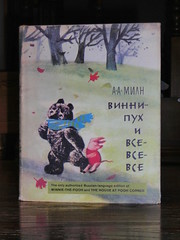 I own two books in Russian. Anyone who knows me is going to laugh, because the titles are so *me*: one is an anthology of poetry, and the other is Winnie the Pooh. The poetry is beyond me at this point. I'm sure I still could read the words, but I could not understand them. Winnie? Maybe.
melanie
Saturday, May 19, 2007
From Oscar Wilde
"Beauty is a form of genius - - is higher, indeed, than genius, as it needs no explanation. It is of the great facts in the world like sunlight, or springtime, or the reflection in dark water of that silver shell we call the moon."
(contributed by Moon Rani)
(contributed by Moon Rani)
From "Booking Through Thursday"
"Where don't you read?"
(Moon Rani's reply) I never read in the bathroom. I don't understand why people read there. There are many comfortable seats in my home, and there are pleasant rooms, so why would I read in the w.c.? If you come for a visit, be sure to pack your own bathroom library because I've none.
(Moon Rani's reply) I never read in the bathroom. I don't understand why people read there. There are many comfortable seats in my home, and there are pleasant rooms, so why would I read in the w.c.? If you come for a visit, be sure to pack your own bathroom library because I've none.
"Booking Through Thursday"
"It happens even to the best readers from time to time… you close the cover on the book you’re reading and discover, to your horror, that there’s nothing else to read. Either there’s nothing in the house, or nothing you’re in the mood for. Just, nothing that “clicks.” What do you do?? How do you get the reading wheels turning again? "
(Moon Rani's reply) On occasion I have found myself in this situation, unlikely as it seems. When I was younger, I took it as a sign of paucity of books, and I would buy or check out more as soon as I could. But now I take it as a sign that my mind is digesting my most recently-read book, and I allow myself time for that. It's a little like leaving a superb meal and thinking, Oh dear - - that was so good that I must eat again right now! But what the situation really calls for, in my case, is a long walk or drive or just solitude and something that works my hands while my mind roams. It might take a day or it might take a month, but I see no time limit to savoring books.
When I was in my teens, I had an endless, aching hunger for reading. I read shampoo bottles and toothpaste tubes. I read recipes on name-brand foods and directions on vacuum cleaners. I read instruction manuals on things for which I was unsure of the uses they had. My voraciousness was indiscriminate, as you can plainly see, and nothing was beneath my craving to read. This is how I discovered that the best way to care for an imported blouse was to "wash in snow flakes and dry with hands." Of course I knew it meant to wash in soap, not detergent, and preferably Ivory Snow flakes, and to let it drip dry, but what a wonderful mental
image it gave me of dashing about in snow flurries, catching as many flakes as I could to wash my blouse, then waving it gently until it was dry.
Oh, dear - - as usual, I've taken the scenic route to get somewhere, and this time I've taken you with me. Suffice to say that I now see seasons in my reading, and I try to appreciate them as they come.
Tea, honey?
Hello, there, this is Moon Rani with a quick report on honey. Usually I comment on honey for tea, but I'd like to add a word or two about broader uses of honey.
Tea and honey are like David and Jonathan, longterm, dear companions. A variety which is new to me is black locust honey. I got it from the local grocer, and it's tops! I like it best in an assertive black tea such as PG Tips or Twining's Irish Breakfast, but it would make delightful friends with milder tea such as Republic of Tea's Vanilla Almond. Black locust is my current choice as I knock back many hot cuppas to see me through another nasty cold. I think it would make excellent tea toddies (as per directions in a winter post). In fact, I think I'll find out about that tonight. I can never sleep when I am flattened by a head cold, and a tea toddy may be just the thing for comfort.
Not long ago, I tried cranberry blossom honey. By itself, it was good. But as the sole sweetener in cranberry pear breakfast muffins, it was nonpareil! Add a lovely, hot cuppa likewise sweetened by cranberry blossom honey and then, as some folks down South say, then you have something.
I love having muffins for breakfast. Since early spring I have experimented with making muffins using honey as the sweetener, and I am very pleased with the results. In fact, I recommend it.
I'd love to share my muffin recipes with you so you could turn out a golden-brown batch for your next tea time, but I am, for the most part, an extemporaneous cook and baker. I can tell you that I once cooked pork loin in a tea-based liquid, but I can't recall exactly how I did it. But here's what I recommend: experiment! Once you find a honey you like, see what else you can pair it with. I am about to try a salad dressing that uses tea. Maybe it will be good, or maybe it will be fit only for, um, flushing, but the experiment will be of interest. Perhaps I'll find a variation I prefer.
Cook with honey! But be advised: consider where your recipe originated. Not long ago, I did something uncharacteristic and used a recipe. It was for spicy chicken with peanut sauce. I had only half the large amount of honey the recipe specified. When my housemate and I dined that evening, we were almost crying from honey overload! The recipe came from a honey company. What does a honey company want to do more than anything? Sell honey. Hence we ended up with chicken that swam in honey. As Housemate said, "Imagine if you'd had all the honey it called for. We'd have passed out!" Later, on a peanut butter jar lid, I found a tasty and affordable recipe for peanut sauce which called for no more than a modicum of honey. Have fun experimenting, but do be careful about your recipe sources.
Sick reading
This is Moon Rani writing. I'm sick in bed with a virus. Know what I did two weeks ago? I was sick in bed with a virus. Monotonous, isn't it?
When I am sick enough, even books bring me no comfort because I lack concentration. But magazines are just the things for times such as these.
An especially lovely and cheerful magazine is "Birds and Blooms," which you can find at www.birdsandblooms.com
It's chockful of beautiful color photos augmented by informative writing and bits of whimsy. It's perfect for times of illness or sadness or bad weather, or in happier times and just because you, too, love birds, gardens and flowers.
Some people go to amazing lengths in their backyards. I recall stories about miniature railroads and cottages and tropical gardens built in back yards. Some people combine artwork and gardening while others construct special back yards for their children or grandchildren.
There are gardening and birdwatching tips, plus many reader submissions from poetry to prose and photos. Be prepared for lots of photos of children in gardens.
I have one advantage when I read "Birds andBlooms," and that is I get the magazine free. A friend's father gives me his old copies. I even use them to help teach a developmentally-delayed child for whom I care.
If this publication is not at your local newstand or bookshop, request it there, or visit the pretty Website. In fact, visit the Website anyway because it's well kept, just like the gardens in the magazine.
Thursday, May 17, 2007
Booking through Thursday
It happens even to the best readers from time to time… you close the cover on the book you’re reading and discover, to your horror, that there’s nothing else to read. Either there’s nothing in the house, or nothing you’re in the mood for. Just, nothing that “clicks.” What do you do?? How do you get the reading wheels turning again?
Nothing to read in the house? Whose house is this? Certainly not mine. Maybe I'm visiting a non-reader's house? Even she would have something to read - a cookbook, a magazine, a newspaper -- Worst-case scenario: I take out my memo pad and a pen, and I write notes for aa poem, an essay, or a blog entry. I've even been known to write little letters in my little handwriting.
Nothing in my house that I'm in the mood for? See above... If I'm too depressed or anxious for sustained reading. I can always read a poem, an essay, or a novel by Barbara Pym. If I can't read Jane and Prudence, my brain must be well and truly fried!
melanie
Tuesday, May 15, 2007
Non-fiction 5: Eat, Pray, Love
Eat, Pray, Love - Elizabeth Gilbert
I confess: the only reason I included this book on my list was its presence on best-seller racks in Borders and Barnes & Noble. I suppose I got what I deserved. At least I had the sense to stop reading it when - well - I'm getting ahead of myself. Be patient.
Gilbert is a seeker. I'm a seeker. (Wouldn't you like to be a seeker too? ) In a memoir, as in life, I seek clear-headedness. In a travelogue, I seek - well, clear-headedness and a sense of Being There. In a spiritual memoir, I seek - well - how about perspective? Some evidence of growth?
Here's a quote that says it all:
Gilbert's travels took her to Italy, India, and Bali. Italy was mostly about food. Even if I, personally, would starve before I ate octopus salad, I can appreciate someone else's appetite. (After all, M.F.K. Fisher wrote about, shall we say, non-standard foods, and her work is stunning.) I can't tell you about Bali, because I bailed out in the middle of India. That's not like me.
I love reading about India. I love Indian music, Indian food, Indian art, Indian thought and spirit. I've read Autobiography of a Yogi, books by Krishnamurti, the Bhagavad-Gita, Rabindranath Tagore, countless books about the Raj. It's difficult to put me off if you're writing about India. Gilbert managed. It wasn't that she arrived at an ashram wanting to pick and choose amongst the necessary disciplines - one expects resistance in a spiritual memoir. It wasn't even the presence of a wry Texan whose comments reminded me of a cross between the late, great Molly Ivins and The Stranger in "The Big Lebowski." It was the moment of enlightenment that involved being bitten half to death by mosquitoes.
Sometimes I can get past mosquitoes. Sometimes I can't. Oh well.
By the way, "The Big Lebowski" is one great film. The Dude abides, you know.
melanie
I confess: the only reason I included this book on my list was its presence on best-seller racks in Borders and Barnes & Noble. I suppose I got what I deserved. At least I had the sense to stop reading it when - well - I'm getting ahead of myself. Be patient.
Gilbert is a seeker. I'm a seeker. (Wouldn't you like to be a seeker too? ) In a memoir, as in life, I seek clear-headedness. In a travelogue, I seek - well, clear-headedness and a sense of Being There. In a spiritual memoir, I seek - well - how about perspective? Some evidence of growth?
Here's a quote that says it all:
The other day in prayer I said to God, "Look - I understand that an unexamined life is not worth living, but do you think I could someday have an unexamined lunch?"Maybe I just wasn't in the mood for this book. (In fact, I just gave a copy to a friend who will like it very much.) What the world needs now isn't love as much as reason and clarity. Without those, love is just an impulse. I need more than the evidence of impulse to want to read a book.
Gilbert's travels took her to Italy, India, and Bali. Italy was mostly about food. Even if I, personally, would starve before I ate octopus salad, I can appreciate someone else's appetite. (After all, M.F.K. Fisher wrote about, shall we say, non-standard foods, and her work is stunning.) I can't tell you about Bali, because I bailed out in the middle of India. That's not like me.
I love reading about India. I love Indian music, Indian food, Indian art, Indian thought and spirit. I've read Autobiography of a Yogi, books by Krishnamurti, the Bhagavad-Gita, Rabindranath Tagore, countless books about the Raj. It's difficult to put me off if you're writing about India. Gilbert managed. It wasn't that she arrived at an ashram wanting to pick and choose amongst the necessary disciplines - one expects resistance in a spiritual memoir. It wasn't even the presence of a wry Texan whose comments reminded me of a cross between the late, great Molly Ivins and The Stranger in "The Big Lebowski." It was the moment of enlightenment that involved being bitten half to death by mosquitoes.
Sometimes I can get past mosquitoes. Sometimes I can't. Oh well.
By the way, "The Big Lebowski" is one great film. The Dude abides, you know.
melanie
Sunday, May 13, 2007
Harry Potter Read along
Seems as if I've been saying "I want to read the whole series" forever.

--and now I shall - one book per week, beginning 9 June. I bought the English editions for my birthday last year (cars have "bonnets" instead of hoods), and I have ordered book 7 from Amazon.uk.
Total immersion - excellent!
melanie
--and now I shall - one book per week, beginning 9 June. I bought the English editions for my birthday last year (cars have "bonnets" instead of hoods), and I have ordered book 7 from Amazon.uk.
Total immersion - excellent!
melanie
Thursday, May 10, 2007
Booking through Thursday
So, judging by last week’s answers, apparently the question I should have been asking was:
Where DON’T you read??
So, judging by last week’s answers, apparently the question I should have been asking was:
Where DON’T you read??
I do not read in the shower, in the dentist's chair, in the car (unless I have an audiobook), under anesthesia, in a movie theater once the film starts, in a restaurant if I'm eating with someone. Really, I can't come up with that many situations where I'd never read. Or breathe.
Wednesday, May 09, 2007
TBR challenge - Katherine Mansfield, a secret life
Katherine Mansfield: a secret life - by Claire Tomalin
That I love the work of Katherine Mansfield probably is apparent from the way I've rattled on here, here, and here. How I wish for a new biography of this doomed and brilliant miniaturist! In the meantime, I recommend this 1987 work by Claire Tomalin.
Tomalin can always be counted on for clarity and an unbiased rendition of a life. In the case of Katherine Mansfield, both must have been difficult. Not only did Mansfield try on various personae and artistic identities, not only did she hide and lie about some of her past - she even changed her name several times, finally alighting on the name we know today.
She was, for her times, more sexually adventurous than many. Her early lovers may have included women. Some of the physical suffering she endured before her death from tuberculosis may have been the result of an STD she contracted, relatively early in her life.
Even as her strength ebbed, she flung herself into her art and the artistic life, socializing with such luminaries as Lady Ottoline, Virginia Woolf, and Aldous Huxley. She and her odious husband lived with the volatile D.H. Lawrence and Frieda Lawrence for a tumultuous period. (Lawrence later based two characters in Women in Love on Mansfield and Lady Ottoline.) Her stories, crystalline and (sometimes) bitter, caught the attention of Virginia Woolf, who considered Mansfield her only true literary threat.
Mansfield's death in the enclave of the mystical Gurdjieff was part of a desperate search for a cure when conventional medicine failed her. Tomalin takes the reader through the last days and last hopes with the dispassionate details that make Mansfield's decisions tragically clear.
Tomalin's biography brought me closest to feeling that I was in the presence of this complicated woman. I recommend it to all who love Mansfield, and all who admire a good biography.
melanie
Monday, May 07, 2007
TBR Challenge: A Changed Man
A Changed Man - Francine Prose
Everyone believes in something, be it God, alchemy, market forces, or mutability. Meyer Maslow, high-profile Holocaust survivor and founder of Brotherhood Watch (BW), believes in all of the above, and then some. As head of an organization that uses publicity and moral pressure to free political prisoners and dissidents, he is surrounded by acolytes who staff his offices and follow his central belief: "peace through change."
The eponymous changed man, Vincent Nolan, leaves his van in the top tier of a parking garage, descends to the gritty heat of Manhattan, and rides the elevator (along with a dwarf - his description, not mine!) to the cool BW headquarters. The women who serve as gatekeepers for Meyer are wary, but they do allow him access.
Vincent tells Meyer his story, mixing truth with wary selectivity. He has, indeed, escaped from the ranks of the American Rights Movement (ARM), a neo-Nazi organization, after an ecstasy-fueled flash of insight in the middle of a rave. He also has stolen his neo-Nazi cousin's van, money, and stash of drugs, details he omits, knowing that they would block his plan to offer himself as a symbol of the type of change dear to Meyer's heart and soul.
Also omitted is the shaky basis of his altered philosophy and the struggle to change his inner vocabulary of borrowed neo-Nazi lingo. He is determined. (" "Attitude is everything,' he reminded himself as he navigated the hot and multicultural streets of Manhattan - the very essence of the evil against which the Aryans fight.") His decisions are fortified by his totem books: Crime and Punishment, and The Way of the Warrior.
At this stage, Vincent is a chameleon in the guise of a changed man, trying on the identity of redemption as he once did with ARM (although without a drug hit). He has drifted from one identity to another, from his mother's New Age airiness to the ARM, on currents of disappointment and neediness, taking on coloration as needed.
Bonnie Kalen, Meyer's fundraising assistant, is a witness to the moment that bonds the two men. Both have tattoos, coloration, as it were - Vincent's death's head and SS thunderbolts vs. Meyer's tattooed numbers. Meyer believes in the alchemy that can transform evil into good, and sees potential where others might suspect a scam.
Bonnie agrees to give Vincent temporary refuge in her home. Her disaffected sons accept the stranger as another peculiarily in their lives, already changed by their parents' divorce. The elder, writing a school paper about Hitler, takes Vincent's hint about Hitler's sexuality and takes it too far, resulting in a minature version of the plight of the dissident journalists that BW deplores. Bonnie, numbed from her divorce from a self-absorbed cardiologist, takes on the challenge of making Vincent ready for his closeup as the new face of BW.
The transformation is not easy. What transformation is? A dress rehearsal for the upcoming glittering fundraiser begins when Vincent spills red wine on his shirt. It ends with Bonnie, drunk and asleep on Meyer's bed. Meyer, who knows that he has burdened Bonnie with the task of taming the rough-edged stranger, looks at his sleeping aide and "feels like a different person. Purified. Washed clean. It's as if he's come through to the other side... he can experience pure love for a fellow human being... This is what God gives you in return for trying to be conscious and do the right thing."
(Yes, even secular saints can lose their way and begin to fret about drug busts at Pride and Prejudice camp, or insert phrases like "moral bungee jump" into their speeches.)
The newly-tamed Vincent has a weakness that almost ends his new career - an allergy to nuts - and he has to fight the effects of a single nut in a salad to deliver his speech about - well - about his escape from a nest of nuts. His escape from ARM has not escaped his cousin's notice, and his desire for cover is destroyed as his heroics are publicized. Raymond, the neo-Nazi cousin, hunts him down and confronts him on a live, Oprah-like talk show...
Francine Prose has conjured a story that uses fairy tale and archetypal situations and characters in a very modern cautionary tale. The reader will encounter Sleeping Beauty, Beauty and the Beast, The Princess and the Pea, dwarves (both physical and moral), Ice Princesses, and the solitary rites of passage that prepare a person to emerge and survive in a new life. The twin devils of political correctness and bigotry are personified in high school classes as well as Raymond's Homeland Encampment. Can it be as dangerous to follow a charismatic leader whose goals are saintly as to follow a demonic historic figure? If Meyer is eager for publicity, is he selling his soul by agreeing to a live appearance with a charismatic talk show host?
I loved this book.
melanie
(Please visit the page I've set up to track my reviews for book challenges.)
Friday, May 04, 2007
I - must - read - this -
I just cataloged this book : The Richness of Life by Stephen Jay Gould. It weighs over 2 pounds. One essay, entitled "Phyletic size decrease in Hershey Bars," includes a chart "Hershey bars bite the dust: a quantitative assessment." His essay, "How the zebra gets its stripes," is a sequel to a previous essay, "What, if anything, is a zebra?" Scientific principles are illustrated using architectural details, and baseball is his joy.
(must - not - buy - this - book - unless - I - see - it - in - Borders - tonight -)

(So why don't I just check out the library's copy? Oh, please...)
melanie
(must - not - buy - this - book - unless - I - see - it - in - Borders - tonight -)
(So why don't I just check out the library's copy? Oh, please...)
melanie
Thursday, May 03, 2007
Booking through Thursday
Reading. In. Public. Do you do it? Why or why not?
Don’t forget to leave a link to your actual response in the comments—or if you prefer, leave your answers in the comments themselves!
Yes yes yes yes. I read in public, I read in private, I read unless I'm knitting or writing or sleeping. Gracious, what would I do if I weren't reading? I'd starve, I'd fade away, I'd become someone else, I'd stagnate.
melanie
Friday, April 27, 2007
National Poetry Month
Today's "Poem in your pocket" printout features Wallace Stevens, Langston Hughes, William Blake - and Emily Dickinson:
"I'm nobody! Who are you?"
I'm nobody! Who are you?
Are you - Nobody - too?
Then there's a pair of us?
Don't tell! they'd advertise - you know!
How dreary - to be - Somebody!
How public - like a Frog -
To tell one's name - the livelong June -
To an admiring Bog!
(In fact, aren't we telling our names to each other - and admiring - each other's Blogs?)
Stephanie of So Many Books has posted a poem by Rumi that will go into my pocket. Here is the beginning of the poem. You will have to visit Stephanie to read the rest - (and please do!)
melanie
"I'm nobody! Who are you?"
I'm nobody! Who are you?
Are you - Nobody - too?
Then there's a pair of us?
Don't tell! they'd advertise - you know!
How dreary - to be - Somebody!
How public - like a Frog -
To tell one's name - the livelong June -
To an admiring Bog!
(In fact, aren't we telling our names to each other - and admiring - each other's Blogs?)
Stephanie of So Many Books has posted a poem by Rumi that will go into my pocket. Here is the beginning of the poem. You will have to visit Stephanie to read the rest - (and please do!)
Book Beauty
Here’s the end of that story about the old woman who wanted
to lure a man with strange
cosmetics. She made a paste of pages from the Qur’an to fill
the deep creases on her face and
neck with.
melanie
Thursday, April 26, 2007
Booking through Thursday
Does what you read vary by the season? For instance, Do you read different kinds of books in the summer than the winter?
melanie
Not really. I used to read one story every winter - "White nights" by Dostoevsky - but since I misplaced my copy of his short stories, I seem to have misplaced that ritual as well. Thinking of it now, I miss the story and the ritual.
The edition I used to read had his other stories as well ("Gentle creature," etc.) but "White nights" was special. The ritual began in high school amongst my friends, the literary misfits who would gather in the prop room behind the school auditorium. We would read aloud from Creely, or Ginsberg, or Rilke, or we would do a reading of "Who's Afraid of Virginia Woolf." (I was Honey, always. No one else wanted to play Honey. They all wanted to be Martha, and they anticipated the moment when they could bray "I DON'T BRAY!!!". It was, I'm afraid, better casting than I'd like to admit. I never could bray.) "White nights" was the nighttime gleam on the white snow as we would walk home - never discussed, but always there.
melanie
Thursday, April 19, 2007
Dystopian challenge
Have you seen this?
Dystopian Challenge
Heaven help me, I just joined.
My selections:
P.D. James - Children of men
Margaret Atwood - Oryx and Crake
Kurt Vonnegut - Cat's cradle
Philip Dick - Do androids dream of electric sheep?
melanie
Dystopian Challenge
Heaven help me, I just joined.
My selections:
P.D. James - Children of men
Margaret Atwood - Oryx and Crake
Kurt Vonnegut - Cat's cradle
Philip Dick - Do androids dream of electric sheep?
melanie
Wednesday, April 18, 2007
Booking through Thursday
- Okay, there must be something you read that's a guilty pleasure . . . a Harlequin romance stashed under the mattress. A cheesy sci-fi book tucked in the back of the freezer. A celebrity biography, a phoned-in Western . . . something that you'd really rather not be spotted reading. Even just a novel if you're a die-hard non-fiction fan. Come on, confess. We won't hold it against you!
Well, yes, there is, but it's only embarrassing because its author has been so thoroughly repudiated as a wise man -- Franny and Zooey by J.D. Salinger. I bought my first copy at the Woolworth's in town when I was about 14. The clerk didn't want to sell it to me because she was afraid it was "dirty" - and when I protested, saying it was about a brother and sister... well, she really hesitated. But she did let me buy it, and it was better than any 5 & 10-cent store candy!
Even at 14, I was a seeker. I had already written a rather long term paper about Taoism for my poor 9th-grade history teacher, and I already had read Lao Tse, Alan Watts, the Bhagavad Gita, Wordsworth, Tennyson -- all of the usual suspects. (Did you know that Timothy Leary did a translation of the Tao Te Ching? My poor history teacher...)
Franny was me, a little older, and blessed with the perfect eccentric family (and old, smelly cat). I knew what it was like to weep, clutching a book as a talisman, or a touchstone. I knew (it's a bitch to be precocious) what it was like to have an existential breakdown. I even knew what it was like to be so damned sick of your own ego that you couldn't face your own talents for fear of being admired and liking it.
I'm still searching for a pea-green, cloth-bound book of wisdom and solace. Maybe one of these days I'll create a commonplace book and bind it in green cloth. Or maybe I should just bind a copy of Franny and Zooey in green cloth! Whatever - I'll continue to dip in and visit Franny, my first literary sister. (Or maybe my second, or maybe my third - I don't want to make Jo March or Rebecca of Sunnybrook Farm jealous. In fact, it's about time I revisited them, too.)
melanie
Sunday, April 15, 2007
On becoming fearless - Arianna Huffington
I promised this would be continued.... From the Stacks challenge
This is not a self-help book. It is neither a memoir nor an anodyne for the fearful. Some of Huffington's principles can be found in books that are anodynes for the fearful woman. Abandon false security, take risks, do not be deterred by those who would call you a bitch.
For that kind of advice, we don't need Arianna. We do need her, though, to understand that the goal of the fearless is not only personal. The stated goal of too many books and media shrinks is too small. Arianna wants to create fearless leaders who can change the world.
The thread that knits this book together is both small and huge. Begin, she says, by withdrawing, meditating, thinking, and creating a inner, quiet place, a true sanctuary that always will be intact and accessible.
Examine, then, your enemies, whether they are people in your life, phobias, local iniquities, global disasters, or the ingrained toxins that want to repel the possibility of change. Do not allow these heaps of foes to dishearten you. To believe that you will only be able to develop fearlessness when the heap becomes smaller is to live behind an counterproductive wall. Vanquish the next enemy, then the next, then the next.
(This imagery reminded me of the Tibetan Book of the Dead, the Bardo Theodol, in which the path to the next life is strewn with things that frightened you. You must challenge those fears to grow into a higher life.)
From your own center, says Arianna, let your action be guided by the compassion and interconnectedness that Sue Smalley (who contributes a brief essay) believes to be encoded in human DNA. (Arianna believes that we have a "Fifth Instinct" for spirituality, also hardwired.) Mythic images may serve as guides for this life - Hestia, for example, or Hermes - and may teach us how to be fearless.
My favorite part of this book showed Arianna's own awakening to the might of the status quo. Early in her career, she wrote a biography of Picasso that enraged the art world because she dared to write the blunt facts of Picasso's relationships with women. These facts showed him to be a mysogynist despot in his private life. The art establishment howled -- but, but, he was a great man! a genius! Geniuses deserve a little slack in how they interact with mortals!
Arianna weathered the tempest and went on to write, speak out, run for political office, and develop The Huffington Post. She embodies fearlessness, and this book may inspire some of the same to you.
(And I still want to be Arianna when I grow up!)
melanie
Teabird's reading challenges
I'm going to create a new blog, where I will keep a running list of the reading challenges that I join, here --
melanie (a/k/a teabird)
Teabird and her challenges
... because I'm having a hard time keeping track of them, myself! My reviews and musings, of course, will remain right here, where they belong!
melanie (a/k/a teabird)
Thursday, April 12, 2007
By the decade challenge: The song of the lark
The Song of the Lark - Willa Cather.
Why did I select this book? I'd never read Cather, and I knew that the plot included opera. Well, now I have, and it does.
The plot - the trajectory of a young girl's life from small-town Colorado to international acclaim as a Wagnerian diva - is almost incidental. The huge Colorado landscape will, one knows, transmute itself into the vistas of Valhalla. The landscape itself will be as much a character as any human being, and will be given a voice more eloquent and true than any human.
In fact, every character's inner life centers on the radiant promise and fulfillment of Thea Kronenborg's artistry. Even the dying thoughts of a hideously-injured trainman are reverences to Thea. Thea contains multitudes, and they all are consumed by Thea.
They all worship with the same voice, designed to express grand principles, both aesthetic and philosophic. Unless I kept track of the the "he said" antecedents, I had no idea who was thinking, talking, or observing.
Perhaps I truly began to lose heart when Theas' musical mentors steered her toward Wagner. I loathe Wagner and nearly everything his music has influenced. Certainly, I always lose interest when a novel seems to be nothing but a duck blind for the author's philosophy. I would have stopped reading well before the end, since I did not care a whit about any character except Thea's mother, but I soldiered on in the name of - oh, who cares....
I'm not sorry that I read this book, but I am glad that it's over.
Notable passages (quotation herein does not constitute approbation by Teabird):
"Though their challenge is universal and eternal, the stars get no answer but that - the brief light flashed back to them from the eyes of the young who unaccountable aspire."
"Artistic growth is, more than it is anything else, a refining of the sense of truthfulness. The stupid believe that to be truthful is easy; only the artist, the great artist, knows how difficult it is."
"He was observant, truthful, and kindly - perhaps the chief requisite in a agood story-teller."
"[A rabbit] seemed to be lapping up the moonlight like cream."
"[Thea's sister had] the kind of fishy curiosity which justifies itself by an expression of horror."
melanie
Booking through Thursday
Have you ever missed an important appointment because you have become so engrossed in a book you forgot the time or were up so late reading that you didn't wake up in time? Been late to work because you couldn't resist the temptation and left the house too late?
Have I ever? I'll even stay up and finish a book I don't like! In fact, I did that last night, reading The Song of the Lark and beginning to write it up. (Watch this space for a snark attack.) I could not go to bed until I'd finished The Woman in White, Savage Beauty, Member of the Wedding, The Great Gatsby (for the 80th time!), Brother Cadafel tales, The Thirteenth Tale (which also disappointed me) - so many books.
As for being late for work, however - no. There I draw the line. Were I to lose my job, how would I buy books?
melanie
Monday, April 09, 2007
National Poetry Month
Poets.org has a list of 30 things we can do to celebrate National Poetry Month.
Hmm. Let's see.
I'm a New Yorker, so I can celebrate Poem in your Pocket Day (a bit early). I keep the poem-a-day calendar on my desk, and often stuff a poem in my pocket. The poem that I stuffed into my pocket today (actually, it's the poem from April 6, but no matter) is by Molly Peacock:
The Land of Tears
You can stop in the spot you're already in
and enter the Land of Tears. It takes
a liquid thought inside the tin
mixing bowl of the brain pan, full of aches
from the scraping of your mind-spoon to make
the journey of the ingredients, the batter
that you turn out into a pan and bake
back into your old self, now new matter,
all because of that liquid thought mixed-up
with your dry milled existence. Curiously
simple tears stop the furiously
churned air, as a door opening up
stops an argument. You know what you meant.
As, after a rain, the air is brilliant.
I think this also qualifies as reciting a poem to family and friends.
I already subscribe to their free newsletter.
Next, I think I'll write to the post office and suggest Allen Ginsberg for the subject of a stamp.
It's a start!
melanie
Saturday, April 07, 2007
We're honored!

Chris of Book-a-Rama has selected Tea Reads for a Thinking Blogger award - an honor, indeed! Thank you!
Now we get to nominate five blogs that make us think. Our choices are:
1. The Crescent Knitter- Khadijha Caitlin's funny and serious thoughts on books, knitting, and community
2. Chitt'svrtti - focus on books of fantasy, myth, magic and knitting
3. Basset Knitter- Paula's knitting, poetry, photography, and humor
4. The Ravell'd Sleave - Bridget's thoughts on knitting, books, and everyday madness
5. Needles on the move- Diane and Heather, who allow us think of possibilities, choices, and doing, not only dreaming.
Now each of the nominees gets to nominate! Here are the rules:
1. If, and only if, you get tagged, write a post with links to 5 blogs that make you think,
2. Link to the thinking blogger post so that people can easily find the exact origin of the meme,
3. Optional: Proudly display the 'Thinking Blogger Award' with a link to the post that you wrote.
Again - thank you! from the three ladies of Tea Reads.
Thursday, April 05, 2007
Booking through Thursday
Booking Through Thursday
- Just out of curiosity, as we enter into Passover and Easter season... have you ever read the Bible? Just the odd chapter or Psalm? The whole thing? (Or, almost the whole thing? It's some heavy reading, of course, and those "begats" get kind of tedious.) I've read the entire New Testament, but only about 2/3 of the Hebrew Bible - which is odd, since I am Jewish. (Or, should I say, I'm a Jewess. I've been called "Jewess" by more people than you would believe!)
- If so, was it from religious motivation or from a literary perspective? Stuck with nothing else to read in a hotel room the Gideon's have visited? Any combination? I took a course as an undergraduate, "The Bible as Literature," which was one of the more useful courses I took as an English major. It illuminated the Biblical references in English and American lit and opened up a new path of understanding. At that point, I had never read the New Testament at all. A few years later, some friends became involved in the Christian Movement and I read it to please them before they took me to visit a Christian commune. (Loved the commune!)
- If not, why not? Against your religious principles? Too boring? Just not interested? Something you're planning on taking care of when you get marooned on a desert island? Not to be controversial, but how could it be a problem to read about other peoples' beliefs? If nothing else, it may begin to illuminate the differences amongst people. (Forgive me, it's my hippie sensibility. My freak flag always will fly!)
- And while we're on the subject... what about the other great religious works out there? Are they more to your liking? Neither more nor less, actually, except for the Tao Te Ching, which I almost included on my list of 10 books I could not live without. I'm not a believer, so I read all religious works (and I do, actually, read all religious works) as literature, and as food for my love of mythology and teaching stories.
Wednesday, April 04, 2007
Ten books you cannot live without
From Kailana's Written World -- (in no particular order)
Alice in Wonderland/Through the Looking Glass- Lewis Carroll
Jane Eyre - Charlotte Bronte
Little Women - Lousia May Alcott
Possession - A.S. Byatt
Pride and Prejudice (or Emma) - Jane Austen
Mrs. Dalloway - Virginia Woolf
Portrait of a Lady - Henry James
Frankenstein - Mary Shelley
Lolita - Vladimir Nabokov
The Picture of Dorian Gray - Oscar Wilde
How hard to narrow it down to ten books that the world (or I) could not live without! I can presume for myself, as of this moment, but the world? The books I chose are good reads and books that (I presume) illuminate many of the aspects of the human spirit, both good and ill. They never fail me.
What would your choices be? Be sure to check out the list of participants on Kailana's blog, and comment there (and here, if you like!) if you decide to participate.
melanie
Tuesday, April 03, 2007
paper dolls
I saw this over at A Garden Carried in the Pocket (Jenclair's wonderful blog) and now I can't stay away --
Legacy Pride paper dolls!
Have you always wanted to dress Jane Austen's Emma? Emily Dickinson? Healthcliff?
Since I'm in the middle of listening to Emma, I linked to her page, but everyone else is just as wonderful. You can choose a doll and dress her/him right there on line. How about Frida Kahlo? Punch and Judy? Maybe I'm a simple girl at heart, but this is so amusing I can hardly stop playing.
melanie
Subscribe to:
Posts (Atom)